


By: Varsha Arya, Asia University
Abstract
Quantum computers are coming and they will EASILY break the security guarantees that the current Internet is built on. A Post-Quantum Internet comprises a layered trust fabric that integrates post-quantum cryptography (PQC), quantum key distribution (QKD), and quantum-resistant protocols to maintain the authenticity, confidentiality and non-reputability in an environment with quantum resources used by adversaries. An in-depth exploration of the central ideas, architectural models, and trust paradigms required to bring about such an Internet. It inspects end-to-end PQC-enabled communications, hybrids of QKD and PQC and cryptographic agility, to IoT, edge and cloud scales. We synthesize evidence from recent work on PQC in protocols, lattice-based and hash-based signatures, PQC-enabled tls, qkd-integrated cryptosystems, blockchain resistance to quantum threats, and IOT-oriented signcryption approaches. The discussion highlights practical challenges such as key management at scale, interoperability across different networks, energy and latency considerations, and governance; and lays out a pragmatic pathway to deployment that aligns standards efforts, pilot deployments, and cross-domain trust models.
Introduction
Nowadays, the security of the Internet is essentially based on public-key cryptography (PKC) (RSA, ECC) which is threatened by quantum computing. Specifically, Shor can quickly resolve the integer factorization and discrete logarithm problems, threatening to compromise security system which are currently in use, and put confidentiality, integrity and authentication of communication and digital signature at risk [1]. The quantum threat is complemented by a broader assessment that even symmetric primitives may require larger keys or more sophisticated protocols in the quantum era. This has led to careful design decisions regarding key lengths and parameters [1]. To this end, researchers and practitioners are pursuing a two-pronged approach: (i) post-quantum cryptography (PQC) replacing vulnerable PKC with quantum-resistant ones and (ii) quantum key distribution (QKD) and related QKD mechanisms that may provide information-theoretic security or enhance trust in distributed systems [1], [2]. Combining PQC with quantum-safe technologies could lead to a rethink on trust in networks, identities, and data flows. This is especially true as we adopt IoT, edge clouds, and cross-domain ecosystems.

Numerous studies have shown that PQC can be integrated into existing Internet architectures, for example, PKC replacements or PQC-enabled signatures as well as practical studies in TLS and cloud environments. This has been complemented by QKD-based security for key exchange and hybrid cryptosystems that combine quantum-safe primitives with information-theoretic or computational security benefits [1], [2]. Researchers are also studying blockchain and other distributed ledger technologies to make them resistant to quantum computing. Ideas are coming forward for quantum-resistant consensus process, digital signature, and cross-domain authentication that can help strengthen trust in decentralized networks [3]. Research studies on post-quantum signcryption and lattice-based cryptography are being undertaken for IoT environments in order to address the limited resources and scalability requirements of constrained devices and future quantum security issues [4], [5]. All these help in creating a Post-Quantum Internet that will sustain trust in the quantum world.
The threats we face and the need to rethink trust in a quantum world cannot be separated from practical deployment. Experts are – among other things – evaluating how the performance, energy, and latency tradeoffs of TLS and Internet protocols vary with PQC. Current efforts to standardize NIST PQC process and security evaluations will frame how the Internet will migrate to quantum-resistant primitives in a manner that allows interoperability across vendors and application domains 5. To conclude, related areas like post-quantum Internet of Things security, quantum-safe identity schemes, and quantum-safe cross-domain authentication highlight the need of improving trust to go beyond cryptographic primitives to include governance, supply chain and multilayer access control [4], [3].
Threat landscape and trust model in a quantum world
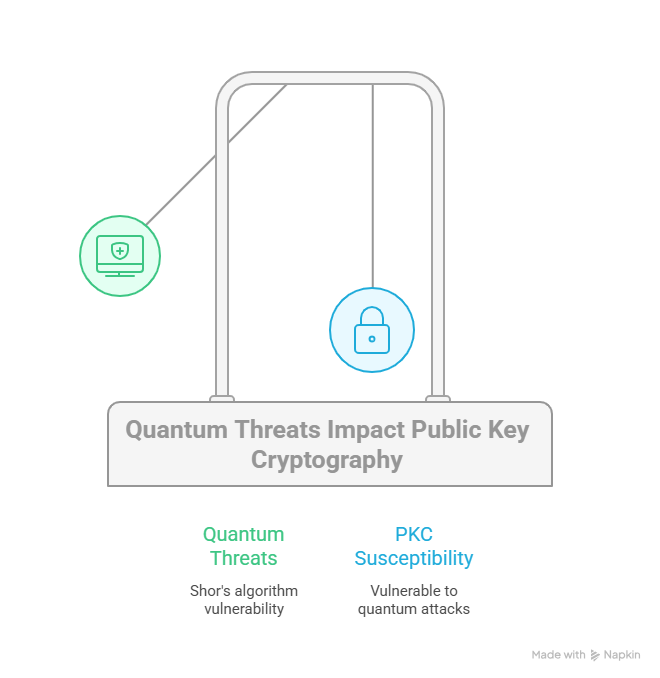
- Quantum threats to PKC: The principal motive to pursue a Post-Quantum Internet is the vulnerability of traditional PKC to quantum attacks, notably Shor’s algorithm, which undermines RSA/ECC-based security and has motivated a shift toward PQC and QKD as complementary strategies [1], [2].
- PQC and QKD as a dual security paradigm: PQC provides cryptographic agility by replacing vulnerable primitives with quantum-resistant alternatives, while QKD provides information-theoretic security for key exchange, enabling hybrid schemes that blend both approaches to strengthen end-to-end security in diverse settings [2], [3].
- IoT and cross-domain resilience: IoT ecosystems demand cryptographic schemes that are both quantum-resistant and lightweight enough for constrained devices, motivating lattice-based and signcryption-based approaches and cross-domain authentication to support scalable, secure interoperation [4], [5].
- Trust beyond encryption: A quantum-aware Internet requires new trust constructs for identity, authentication, data integrity, and governance, including quantum-resistant blockchain concepts and hybrid infrastructures where trusted components (PKI, CAs, edge devices) must operate under quantum threat models [3], [5].
Post-Quantum Internet Architecture: Core Building Blocks
- KEMs (Key Encapsulating Mechanisms) based on lattices, in combination with post-quantum digital signatures (lattices or hash-based digital signatures), can facilitate the replacement of legacy PKC while maintaining backward compatibility with existing protocols. It would be the combination of KEMs with signatures that forms the essential instantiation of lattice-based authenticated key exchange which will allow the authenticated establishment of sessions in a quantum-safe manner [6]. Moreover, end-to-end PQC-enabled communication systems have emerged already and further this indicates a path towards quantum-safe data paths (ABI) between processing units (PUs) [4]. Furthermore, the performance analyses of PQC algorithms for digital signatures point out a balance between cost, security, and feasibility of deployment [5].
- Quantum Key Distribution (QKD) provides affords information-theoretic security for keys while post-quantum cryptography (PQC) protects the data stream with quantum-resistant primitives. Hybrid schemes that integrate QKD with post-quantum cryptography (PQC) have been shown to securely and end-to-end, in practice with formal security guarantees, enabling a hybrid quantum-safe cryptosystem that remains secure as long as at least one component remains uncompromised [3], [6]. The combination of quantum key distribution (QKD) with post-quantum cryptography (PQC) in hybrid protocols has shown practical success in real-world deployments dealing with their deployment and performance issues [3].
- Heterogeneous and cross-domain interoperability of IoT networks are currently researched under post-quantum protection, including signcryption schemes based on lattice problems for sending confidential and integrity protected interactions in resource constrained environment [4], [5]. The researchers are studying cross-domain identity authentication which is based on lattice signatures and related post quantum cryptography (PQC) primitives [7]. In decentralized networks and blockchains, quantum resilience is pursued through quantum-resistant signatures and cross-domain trust mechanisms that fit within the existing infrastructure of blockchains [3].
- Future blockchains may be retrofitted or designed from scratch with PQC primitive so that they can be backed up from violations of its integrity and authenticity using quantum computers (QCs) [6]. The experimental work related to quantum-resistant blockchain architectures is mostly focused on the practical aspects of quantum-safe cryptography integration into a distributed ledger with performance and security guarantees [3].
Key exchange, authentication, and cryptographic agility in a quantum world
- Lattice-based AKE and PQ signatures. We study the application of lattice-based cryptography in the form of KEM-based approaches along with EUF-CMA signatures. They offer quantum resistance and security assurance proved in the standard model. We study the efficient, secure authenticated key exchange for Internet services that forms the basis of PQC-enabled session establishment [6]. Practical evaluations of PQC in TLS are carried out to assess performance or security consequences in real-life protocols in complementing the pattern [1].
- The post-quantum signcryption schemes for IoT environments that we proposed to ensure confidentiality and authenticity while being compatible with IoT architectures provide a practical quantum-safe data path for IoT [5].
- Combining techniques and practical deployment of quantum safe cryptosystems QKD based key exchange (key-ing) with post-quantum cryptography (PQC) cryptographic material is possible; such combinations are already being implemented in experimental demonstrations [3]. These implementations indicate a route towards practical deployment that is secure even when only partially quantum-safe.
Security and privacy considerations in a quantum world
- With the rise of PQC and QKD technologies, a closer look at protocol-level energy usage, latency and memory footprints is needed. This is especially true for the TLS handshakes from IoT edge devices. The reason why asymmetric and symmetric energy-cost analyses of cryptographic approaches reveal that symmetric primitives are often energy-efficient in post-quantum settings, is driving crypto agility and the optimization of protocols to balance security and performance [5].
- Post-quantum IoT security refers to any security survey and design dedicated to a post-quantum implementation that is IoT-specific (internet-connected) sensitive and scalable architectures. The main aim should be quantum-resistance. Existing architectures should be able to integrate despite the fact that IoT devices differ in capability and nature, including aspects like key management or interoperability issues [5].
- Signature designs are developed to facilitate authentication of devices and non-repudiation in a post-quantum world [7]. It is scalable and enables device enrollment along with event integrity of edge computing [9][8].
Roadmap toward a deployment-ready Post-Quantum Internet
- Standards and standardization: The transition to a quantum-aware Internet will rely on ongoing standardization efforts for PQC primitives and secure interoperability, including TLS and Internet protocol adaptations, as well as cross-domain authentication frameworks, to enable vendor- and domain-agnostic deployments [1], [5].
- Hybrid deployment roadmaps: Implementations that combine QKD with PQC, along with end-to-end PQC-based cryptosystems, offer practical strategies for gradually upgrading networks while preserving security guarantees during the transition period [3], [6].
- IoT and edge-scale adoption: IoT-specific PQC approaches, including signcryption and lattice-based signatures, can be integrated into IoT management platforms and edge gateways to provide quantum-resistant security for large-scale deployments [4], [5].
- Governance and risk management: A comprehensive quantum-era security program requires governance around cryptographic agility, supply chain resilience, and cross-domain trust frameworks to ensure that quantum risk is managed holistically across networks, devices, and applications [1], [3].
Conclusion
The Post-Quantum Internet means we do not put all our eggs in one basket and that we use a proper strategy to deploy a crypto-agile internet combining PQC, QKD and suitable quantum-safe multiple layers and different protocols in different layers of the internet. Using complete post-quantum encryption for key exchange and signatures, hybrid architectures for QKD and post-quantum encryption, post-quantum encryption for IoT devices as well as post-quantum encryption for inter-domain trust can ensure the Internet’s confidentiality, integrity and authenticity coffers deliver on their promise in a world where quantum capabilities threaten philosophical ideas. The synthesis of current research points to a practical, staged path: secure transitions of TLS and Internet protocols, scalablePQCs enabled identities and signatures, interoperable cross-divisional authentication, and hybrid quantum-safe deployments leveraging QKD where viable. Though important issues remain, especially with key management in scale, energy efficiency and interoperability across layered networks, the body of work surveyed here presents viable and concrete building blocks and deployment patterns that may be built on to create a resilient, quantum-aware internet for the next era of communications.
References
- M. Feltovic, “From theory to practice: the role of cryptography in securing blockchain networks”, Mest Journal, vol. 12, no. 2, p. 93-102, 2024. https://doi.org/10.12709/mest.12.12.02.12
- Y. Zhang, P. Duan, C. Li, H. Zhang, & H. Ahmad, “Preserving privacy of internet of things network with certificateless ring signature”, Sensors, vol. 25, no. 5, p. 1321, 2025. https://doi.org/10.3390/s25051321
- P. Vithalkar, “Cryptographic protocols resilient to quantum attacks: advancements in post-quantum cryptography”, cana, vol. 31, no. 3s, p. 520-532, 2024. https://doi.org/10.52783/cana.v31.805
- Z. Yang, T. Salman, R. Jain, & R. Pietro, “Decentralization using quantum blockchain: a theoretical analysis”, Ieee Transactions on Quantum Engineering, vol. 3, p. 1-16, 2022. https://doi.org/10.1109/tqe.2022.3207111
- M. Müller, J. Jong, M. Heesch, B. Overeinder, & R. Rijswijk-Deij, “Retrofitting post-quantum cryptography in internet protocols”, Acm Sigcomm Computer Communication Review, vol. 50, no. 4, p. 49-57, 2020. https://doi.org/10.1145/3431832.3431838
- S. Debnath, T. Choudhury, P. Stănică, K. Dey, & N. Kundu, “Delegating signing rights in a multivariate proxy signature scheme”, Advances in Mathematics of Communications, vol. 17, no. 3, p. 681-696, 2023. https://doi.org/10.3934/amc.2021016
- Y. Yang, P. Li, S. Ma, Q. Xiaocong, K. Zhang, L. Wanget al., “All optical metropolitan quantum key distribution network with post-quantum cryptography authentication”, Optics Express, vol. 29, no. 16, p. 25859, 2021. https://doi.org/10.1364/oe.432944
Cite As
Varsha A (2025) Post-Quantum Internet: Rethinking Trust in a Quantum World, Insights2Techinfo, pp.1