


By: Shavi Bansal, Insights2Techinfo, India Email: shavi@insights2techinfo.com
Abstract.
Generative AI systems are everywhere in every field delivering anything from content to code and decision support at scale. But using them creates problems for safety and security and governance that existing security systems find hard to handle. This article combines organized frameworks, automated tools, and governance considerations to unite recent red-teaming practices for generative models. It aims to inform ethical hackers, security researchers, and policymakers. The work outlines how to stress-test GenAI and create mitigation measures to ensure responsible deployment. It does so by bringing into play the PIEE Cycle for red-teaming large language models, autonomous and AI-augmented testing paradigms, collaborative testing suites, and domain-specific demonstrations. The synthesis shows how adversaries could use prompt paths, data movement or model behavior and how defenders can make red-teaming a practice within risk management, product development and organizational governance.
Introduction
Generative AI has reached a high-level of commercial viability with scalable generation of text, images, and code now possible with far reach security, privacy, reliability implications [1]. As they can be used for both beneficial and malicious purposes, the red teaming of such applications and systems is gaining momentum as a defence strategy. The trend of ethical hackers and researchers being commissioned to stress test GenAI to find exploitable weaknesses continues to grow as threats from adversaries or unintentional misalignment, bias, data leakage, etc. ([1], [2], [3]). Nevertheless, traditional safety mechanisms often fail to assess GenAI risk in a thorough manner as these systems involve learning and generation and exhibit domain-specific behaviour that is a function of deployment [1], [2]. In light of this, researchers have pushed for structured and repeatable red-teaming processes, automated attack platforms, and governance mechanisms to ensure safety-by-design in GenAI products [4], [5], [6], [7].

In this article, we survey the landscape of red teaming for generative models. In particular, we focus on three areas: (i) formal frameworks that structure activities for stress testing, (ii) automation and AI-augmented techniques that scale coverage of attack vectors, and (iii) governance and real-world examples that show how red teaming informs risk management and policy. The synthesis brings together insights from domain-specific and cross-domain studies to explore how ethical hackers test generative models, what attack surfaces matter most, and how organizations can operationalize red-teaming as a core part of security, safety and compliance.
All operative artefacts of GenAI systems are adversarially exposed and need to withstand probing and exploitation across data, prompt and interaction dimensions. The reason for a formal Red Team is that GenAI’s capabilities can be misaligned, misused, or otherwise cause harm in the wild, giving rise to safety and governance problems that need stress-testing [1], [2], [3]. A strong red teaming strategy could highlight weaknesses in prompts, data, alignments and output governance; and unearth systemic risks such as privacy leakage, prompt injection and social engineering-enabled misuse. A mature response is essentially one involving governance-oriented mitigations like model evaluation; human-in-the-loop oversight; GenAI-specific red-teaming; systematic spreading of threat intelligence [1], [2], [3], [9].
There are three common areas that GenAI red-teamers look at. 1) Prompt pathways that provoke bad behavior, or jailbreak a model altogether. 2) Data pathways that lead to leakage or inference of sensitive data. 3) Output pathways that may lead to misinformation or harmful generation. According to [8], adversarial testing allows for the manipulation of internal decision logic. This helps in the exploitation of never-before-seen novel mechanisms. Furthermore, the testing extends to agentic or autonomous AI components. The larger safety net can be improved by encouraging more multi-party red-teaming, pooling perspectives and domain expertise in order to exploit vulnerabilities that automated or siloed approaches miss [5], [3]. When all put together, these observations highlight the need for including red-teaming in the GenAI lifecycles, beginning with development and testing to deployment and governance.
Frameworks, Methodologies, and Tools for Red-Teaming Large Generative Models
PIEE Cycle
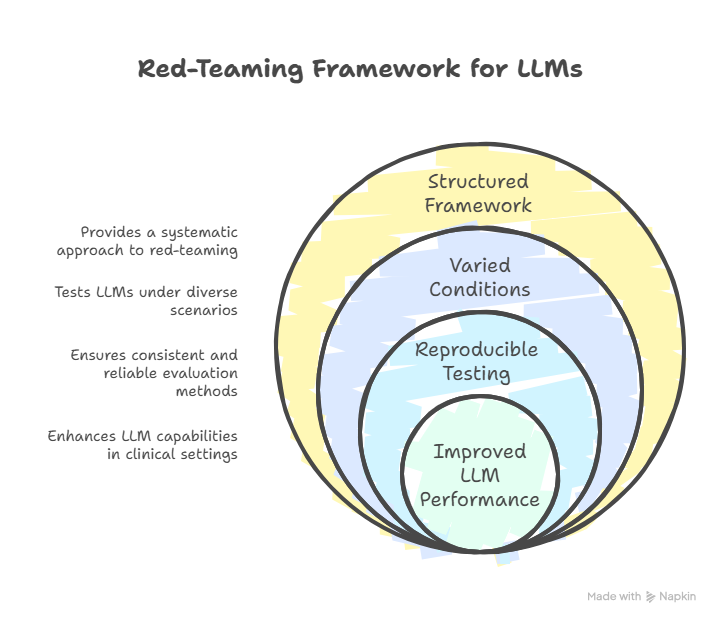
A structured framework for red-teaming LLMs in clinical decision-making. Structured red-teaming frameworks provide reproducible means to probe LLMs under varied conditions. The PIEE Cycle is another technique we use to test AIMs for HSDM. The PIEE Cycle consists of the four parts: 1) Planning and Preparation 2) Information Gathering and Prompt Generation 3) Execution 4) Evaluation. The PIEE Cycle can be generalized beyond clinical contexts for HSDM addressing other GenAIs [4]. The PIEE Cycle stresses the importance of scoping early, identifying risks, engineering early, experimenting in a controlled way and evaluating your model behaviour/output. By separating phases and deliverables, PIEE enables systematic coverage of attack-vectors and the facilitation of governance through documentation and traceability [4]. Each step of the cycle emphasizes preparation, gathering information and evaluation after an experiment. This closely resembles adversarial testing and risk management principles. Overall, it provides a framework that practitioners can implement across several domains and model families [4].
Auto Red Teamer.
Fully automated red teaming solutions can address the large scale and high pace of new attack vectors that arise in GenAI systems. The platform, AutoRedTeamer, purports to provide a fully autonomous, end to end red teaming framework. This system is capable of continuously integrating new attack methods and continuous learning of attacks through an associated lifelong attack knowledge. AutoRedTeamer extends attack surface coverage and minimizes over-reliance on hand crafted prompts by automating the discovery, execution, and refinement of adversarial tests, facilitating the stress-testing of evolving models 6. The framework shows that automated red-teaming can systematically capture vulnerabilities across the prompt, data, and behaviour dimensions, while creating traceable artifacts that support governance and auditability of the automated red-teaming process [6].
AI-Augmented Penetration Testing.
A New Frontier in Ethical Hacking Using AI to Penetration Testing. The AI-augmented penetration testing process extends the traditional pentest lifecycle with a range of machine-learning–driven enhancements, include reconnaissance, vulnerability prediction, and reinforcement-learning-driven dynamic attack-path generation. This plan makes it easier for the company to expand and change to meet new GenAI threats. It is more efficient for triage and prioritization of fixes [7]. The AI-augmented design shows how learningbased elements may be used to complement human assessors by probing non-intuitive attack paths and rapidly revising models of risk as new data arrives [7].
Collaborative testing suite for newly developed generative AI algorithms.
A joint testing suite for the new algorithms and agents, GenAI, illustrates the merit of team-based red-teaming across disciplines such as engineering, policy, and ethics. The high-severity issues were greatly diminished and many other vulnerabilities were solved, while the complex remediation on multi-ecosystem depolyments improved [5]. Red teaming widely and continually will create stronger defences and make models more resilient to coordinated multi-vector attack
Red Teaming in Quantum-Safe Contexts.
As GenAI begins to intersect with quantum-era cryptography and quantum-era communications, red-teaming will increasingly require models capable of probing standards and protocols that are quantum-resistant. A framework for testing and red-teaming quantum-resistant cryptographic standards includes artificial intelligence tests and automated exploitation simulations, as well as fuzzing of protocols in order to identify hidden weaknesses and to direct cryptographic hardening for next-generation networks [10]. This shows that red teaming ideas extend to highly technical physics-based areas, where adversarial testing may expose corner-case weaknesses in quantum-security implementations and AI-assisted defenses.
Threat Modeling in Agentic AI.
We need to think through emergent risks if we provide roles to agents that are only partially agentic. This includes the risks of misalignment, goal leaking, spill-overs, goal leakage, and externally-calibrated out-of-distribution behaviour. The latest study suggests that threat modeling is an important part of red-teaming for agentic systems. It looks at data leaks, command-execution risks and “exploitable” decisions. Integrating threat modeling with adversarial testing aids in proactively mitigating issues and designing safer agentic architectures. Having established the point that agentic behavior can pose significant risks, this viewpoint heavily reinforces the need for a structured, repeatable red-teaming which incorporates agentic behavior as a weighty dimension of risk [8].
Threat Surfaces, Attack Vectors, and Defensive Postures
Prompt Injections and Jailbreak-Style Attacks
Prompt-based manipulation—intending to coerce a model into producing harmful, biased, or disallowed content—represents a dominant attack vector in GenAI red-teaming. Adversarial prompt construction, jailbreak strategies, and prompt leakage can undermine model safety and violate policy constraints, underscoring the need for robust prompt governance and testing across diverse prompt pipelines [2], [1]. The literature emphasizes monitoring for prompt-induced behaviors and implementing guardrails, input sanitization, and prompt-robust evaluation as essential components of a defense-in-depth strategy [2], [1].
Data Handling, Leakage, and Privacy Considerations
GenAI systems’ training data provenance and on-demand processing pose privacy and data-leak risks. Red-teaming frameworks stress testing data-handling pathways, including how inputs could be exploited to elicit sensitive information or model memorization. Governance-driven mitigations—such as data minimization, access controls, data-use policies, and post-hoc auditing of model outputs—are highlighted across sources as critical for reducing privacy exposure and risk of leakage [1], [2], [9].
Social Engineering and Behavioral Exploitation
LLMs can be leveraged to generate tailored social-engineering content, deepen impersonation, or fabricate plausible narratives, creating new challenges for defenders and policymakers. Defensive countermeasures emphasize the need for real-time detection, user education, and adaptive, intelligence-driven responses to evolving social-engineering tactics; these insights are reinforced by studies on AI-driven social engineering countermeasures and the broader threat landscape [3], [2].
Exploits in Agentic AI and Emergent Misuse Scenarios
Agentic AI introduces additional layers of risk, including exploitation of autonomy and misalignment between agent objectives and user safety. Threat modeling and vulnerability analyses focusing on agentic components illuminate possible data-leakage, command-execution, and behavior-exploitation risks that red-teamers must anticipate and mitigate [8]. The combined emphasis on agentic risk and conventional attack surfaces reinforces the need for comprehensive, domain-spanning red-teaming programs [8].
Governance, Ethics, and Risk Management in GenAI
Red-Teaming Governance and risk management are inseparable from effective red-teaming of GenAI. Foundational works argue for governance-oriented mitigations—model evaluation protocols, human-in-the-loop oversight, transparent threat intelligence sharing, and the structured dissemination of findings—so that red-teaming informs safe deployment and responsible stewardship of GenAI systems [1], [9]. The defense-oriented literature also highlights the importance of human accountability, ethical considerations, and fairness auditing in security practices, particularly when red-teaming intersects with social engineering and decision-support functions [2], [3], [9]. As GenAI deployment accelerates, blue-team readiness must align with red-team insights to embed risk-aware design choices into product lifecycles, incident response plans, and regulatory compliance efforts [1], [2], [3], [9].
Challenges and Future Directions
Challenges hinder red-team practices on Generative AI, despite progress. With the increase in model capabilities, there is an increasing demand for a frequently updated set of attacks and testing paradigms, which calls for an automated and autonomous testing platform [6], [7]. The need for governance and transparency requires good documentation, versioning and auditable processes so that the outputs of red-teaming result in actual risk mitigations and policy actions[1][9]. Moreover, the intersection of GenAI with quantum security and other specialized areas means that red teaming frameworks also need to extend into quantum-resistant testing and domain-specific threat modelling in order to be able to capture emerging surfaces of risk [10]. Literature suggests a multi-pronged path forward: scale automated red-teaming while keeping it domain relevant; embed red-teaming into processes like SDLC and risk management; governance structures to translate adversarial findings to actionable mitigations, accountability and policy guidance [1], [5], [6], [7], [8], [9].
Conclusion.
The present-age need is red-teaming AI for generative models, which is a crucial activity for responsible development, deployment, and governance of AI. WIth the help of Structured frameworks like the PIEE Cycle, we get repeatable workflows ensuring that the test process aligns with risk management objectives. Further, autonomous testing and AI-augmented testing approaches expand coverage and scalability against fast-moving threats. Collaborative testing ecosystems and quantum-aware red-teaming enable defensive testing to be executed holistically across technologies. Detection and mitigation are achieved for conventional and emerging surfaces. Real-world incidents in healthcare and other critical areas highlight the advantages of including red-teaming as part of product lifecycle and organizational governance. There is a necessity for continuous governance-informed stress-testing of GenAI systems. As GenAI becomes mainstream, red-teaming will continue to be key to security and privacy.
References:
- K. Orpak, “Generative ai and cybersecurity: exploring opportunities and threats at their intersection”, Maandblad Voor Accountancy en Bedrijfseconomie, vol. 99, no. 4, p. 221-230, 2025. https://doi.org/10.5117/mab.99.149299
- “Adversarial attacks on large language models (llms) in cybersecurity applications: detection, mitigation, and resilience enhancement”, International Research Journal of Modernization in Engineering Technology and Science, 2024. https://doi.org/10.56726/irjmets61937
- P. Rajgopal, “Ai threat countermeasures: defending against llm-powered social engineering”, ijiot, vol. 5, no. 02, p. 23-43, 2025. https://doi.org/10.55640/ijiot-05-02-03
- M. Trabilsy, S. Prabha, C. Gomez-Cabello, S. Haider, A. Genovese, S. Bornaet al., “The piee cycle: a structured framework for red teaming large language models in clinical decision-making”, Bioengineering, vol. 12, no. 7, p. 706, 2025. https://doi.org/10.3390/bioengineering12070706
- P. Radanliev, “Collaborative penetration testing suite for emerging generative ai algorithms”, Applied Intelligence, vol. 55, no. 16, 2025. https://doi.org/10.1007/s10489-025-06908-1
- A. Zhou, K. Wu, F. Pinto, Z. Chen, Y. Zeng, Y. Yuet al., “Autoredteamer: autonomous red teaming with lifelong attack integration”, SI, vol. 2, no. 2, 2025. https://doi.org/10.70777/si.v2i2.14433
- S. Thapaliya and S. Dhital, “Ai-augmented penetration testing: a new frontier in ethical hacking”, Int. J. Atharva, vol. 3, no. 2, p. 28-37, 2025. https://doi.org/10.3126/ija.v3i2.80099
- “Unveiling security vulnerabilities in agentic ai: threat modeling, exploits, and mitigation strategies”, International Journal of Advanced Research in Electrical Electronics and Instrumentation Engineering, vol. 14, no. 08, 2025. https://doi.org/10.15662/ijareeie.2025.1408013
- S. Frid, “Bridging generative ai and healthcare practice: insights from the genai health hackathon at hospital clínic de barcelona”, BMJ Health & Care Informatics, vol. 32, no. 1, p. e101640, 2025. https://doi.org/10.1136/bmjhci-2025-101640
- P. Radanliev, “Red teaming quantum-resistant cryptographic standards: a penetration testing framework integrating ai and quantum security”, The Journal of Defense Modeling and Simulation Applications Methodology Technology, 2025. https://doi.org/10.1177/15485129251364901
Cite As
Bansal S. (2025) Red Teaming AI: How Ethical Hackers are Stress-Testing Generative Models, Insights2Techinfo, pp.1