


By: Sahil Kumar, Department of Computer Science Chandigarh College of Engg. & Tech. Chandigarh, India co24355@ccet.ac.in
Abstract
SQL Injection (SQLi) remains one of the most prevalent and damaging vulnerabilities in modern web applications. By manipulating unvalidated input, attackers can execute arbitrary SQL commands, bypass authentication, exfiltrate sensitive data, and even take control of entire databases. This article explores the structure and execution of SQLi attacks, their real-world impact, and the latest research trends in detection and prevention. We discuss emerging threats, the role of AI in both exploiting and mitigating SQLi, and provide projections for the future of database security in a rapidly evolving cyber landscape.
Keywords: SQL Injection, Web Application Security, Database Exploitation, Cybersecurity, Input Validation
Introduction
Databases form the backbone of almost every web application, storing critical information such as financial transactions, user credentials, and medical records. As organizations increasingly rely on interconnected systems, the potential attack surface for malicious actors expands significantly. One of the oldest yet still highly effective forms of attack is SQL Injection (SQLi) [2]. Despite being listed in the OWASP Top 10 for over a decade, SQLi continues to be a common cause of data breaches due to insecure coding practices, legacy systems, and inadequate testing [1].
This article examines the anatomy of an SQLi attack, from vulnerability discovery to exploitation, and evaluates mitigation strategies supported by contemporary research.
The Emergence of SQL Injection as a Persistent Threat
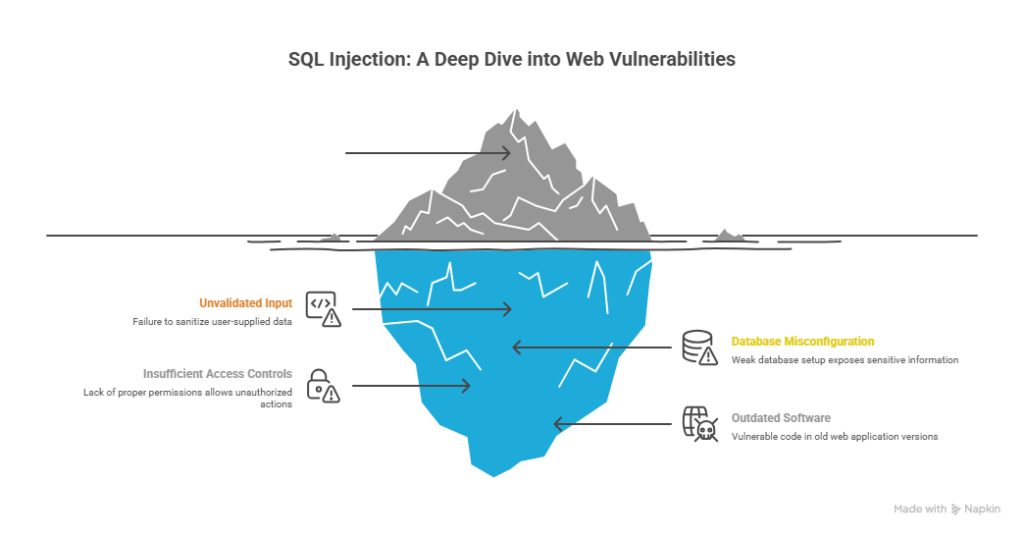
First documented in the late 1990s, SQLi quickly became one of the most popular web exploitation techniques [3]. Its enduring relevance lies in the fact that many applications still concatenate user input directly into SQL statements without adequate sanitization. SQLi attacks can range from simple login bypasses to advanced multi-stage intrusions involving privilege escalation and lateral movement within corporate networks.
Key Benefits for Attackers Exploiting SQL Injection
- Real-Time Data Extraction – SQLi enables instant retrieval of sensitive records such as passwords, credit card details, and personal identification numbers. For instance, in the 2014 Breach of Tesla’s website, attackers leveraged SQLi to extract backend system data [4].
- Authentication Bypass – By injecting always-true conditions such as ‘ OR 1=1 –, attackers can bypass login screens and gain administrator privileges [12].
- Privilege Escalation and System Compromise – Advanced SQLi can invoke stored procedures or OS-level commands, allowing attackers to execute arbitrary code on the server [6][15].
Real-World Examples
- British Airways Breach (2018): SQLi was suspected in the compromise of payment card details for over 380,000 customers [6].
- MOVEit Transfer Vulnerability (2023): Exploited SQLi flaws in managed file transfer software led to significant data exposure for government agencies and corporations [1].
- TSA/FlyCASS Incident (2024): Researchers demonstrated SQLi to create unauthorized pilot profiles in the U.S. Transportation Security Administration’s access control system [7].
Challenges & Ethical Considerations
SQLi defense is complicated by the sheer diversity of web frameworks, programming languages, and database systems. Ethical concerns arise when security researchers test live systems for vulnerabilities in so-called “grey-hat” activities which may breach legal boundaries despite being intended for public safety [5].
Moreover, attackers increasingly use AI to craft polymorphic SQLi payloads capable of evading traditional Web Application Firewalls (WAFs) [8]. This creates a dual-use dilemma where AI serves both attackers and defenders.
Current Research and Defensive Approaches
- Machine Learning Detection Models: Recent studies have shown that deep learning models can achieve over 99% accuracy in SQLi detection by analyzing query patterns and network traffic [11].
- Natural Language Processing (NLP) for Query Analysis: Transformer-based models are being trained to distinguish legitimate queries from maliciously crafted ones in real time[9].
- Runtime Query Parameterization: Automated query sanitizers can enforce parameterized execution at the database engine level, reducing reliance on developer discipline [6][14].
Future Projections
By 2030, SQL attack surfaces are expected to expand beyond traditional web forms into emerging domains like voice-activated assistants and AI-driven database query systems. Injection via GraphQL, NoSQL, and natural language-to-SQL interfaces is likely to rise [10]. Organizations will increasingly adopt AI-augmented intrusion detection systems, but adversaries will equally leverage AI to automate payload mutation and bypass controls.
Conclusion
SQL Injection is not a relic of early internet security flaws — it is a living, evolving threat. Its continued prevalence reflects both technological debt in legacy systems and human error in new development. As attack vectors diversify and adversaries integrate AI into their arsenals, defending against SQLi will require proactive coding standards, real-time detection capabilities, and cross-disciplinary collaboration between developers, security teams, and researchers.
References
- OWASP(2023) Top Ten.
- Halfond, W. G., Viegas, J., & Orso, A. (2006, March). A Classification of SQL Injection Attacks and Countermeasures. In ISSSE.
- Clarke-Salt, J. (2009). SQL injection attacks and defense. Elsevier.
- Zetter, K. (2014). Tesla website and Twitter accounts hacked. Wired.
- Casey, E. (2011). Digital evidence and computer crime: Forensic science, computers, and the internet. Academic press.
- Pagliery, J. (2018). British Airways data breach. CNN Business.
- Matsakis, L. (2024). Researchers exploited the TSA database to create fake pilots. The Verge. https://www.nature.com/articles/s41598-023-48845-4
- Qu, Z., Ling, X., Wang, T., Chen, X., Ji, S., & Wu, C. (2024). AdvSQLi: Generating Adversarial SQL Injections against Real-world WAF-as-a-service. IEEE Transactions on Information Forensics and Security, 19, 2623-2638.
- Dasari, N. S., Badii, A., Moin, A., & Ashlam, A. (2025). Enhancing SQL Injection Detection and Prevention Using Generative Models. arXiv preprint arXiv:2502.04786.
- Küfeoğlu, S., & Akgün, A. T. (2023). Cyber resilience in critical infrastructure. CRC Press.
- Vats, T., Singh, S. K., Kumar, S., Gupta, B. B., Gill, S. S., Arya, V., & Alhalabi, W. (2024). Explainable context-aware IoT framework using human digital twin for healthcare. Multimedia Tools and Applications, 83(22), 62489-62490.
- S. Kumar, S. K. Singh, N. Aggarwal, and K. Aggarwal, “Evaluation of automatic parallelization algorithms to minimize speculative parallelism overheads: An experiment,” Journal of Supercomputing, vol. 77, no. 6, pp. 5983–6004, 2021.
- S. Kumar, S. K. Singh, N. Aggarwal, B. B. Gupta, W. Alhalabi, and S. S. Band, “An efficient hardware-supported and parallelization architecture for intelligent systems to overcome speculative overheads,” Journal of Intelligent & Fuzzy Systems, vol. 42, no. 3, pp. 2465–2476, 2022.
- Kumar, S., Singh, S. K., Aggarwal, N., & Aggarwal, K. (2021). Evaluation of automatic parallelization algorithms to minimize speculative parallelism overheads: An experiment. Journal of Discrete Mathematical Sciences and Cryptography, 24(5), 1517-1528.
- Singh, S. K. (2021). Linux yourself: concept and programming. Chapman and Hall/CRC.
- Al-Ayyoub, M., AlZu’bi, S., Jararweh, Y., Shehab, M. A., & Gupta, B. B. (2018). Accelerating 3D medical volume segmentation using GPUs. Multimedia Tools and Applications, 77(4), 4939-4958.
- Gupta, S., & Gupta, B. B. (2015, May). PHP-sensor: a prototype method to discover workflow violation and XSS vulnerabilities in PHP web applications. In Proceedings of the 12th ACM international conference on computing frontiers (pp. 1-8).
Cite As
Kumar S. (2025) The Anatomy of an SQL Injection Attack, Insights2Techinfo, pp.1