


By: Bhavya, Department of CSE, Chandigarh College of Engineering and Technology, Panjab University, Chandigarh, Email: MCO24383@ccet.ac.in
Abstract:
As technology progresses, education is changing as well, and Generative AI and intelligent learning systems have ushered in a new era in modern education. This article discusses the use of large language models and intelligent platforms, discussing the technical processes involved in their pipeline from data acquisition to personalized learning and feedback. Some important uses include automated content generation, virtual teaching, and assistive technologies, but it also tackles issues such as privacy, bias, academic dishonesty, and inequity. While Generative AI can revolutionize education, there are many challenges that must be taken into consideration.
Keywords: Generative Artificial Intelligence (AI), smart learning systems, adaptive learning, large language models, personalized learning, intelligent tutoring systems.
- Introduction
Do you remember being taught in classrooms where every student was able to learn according to his/her pace, and where a slow learner got additional help, a quick learner got harder materials, and teachers were relieved from handling all these issues themselves? That could seem like a product of science fiction a couple of years ago, yet it has already become a part of reality for many schools and colleges worldwide. All thanks to Generative AI and smart learning systems! These technologies are gradually making their way into our education sphere.
There are several issues that modern education faces, such as increasing classes’ sizes and student demands, as well as diversity of each student’s abilities. Also, there are some problems with traditional ways of teaching. Teachers tend to get overloaded with work while students think that the lectures are boring. In this respect, technology, and especially AI tools, are gaining more relevance nowadays [1].
During recent years, artificial intelligence technology has become not only a powerful tool for conducting business operations or performing scientific research but also an efficient tool for the educational domain. Specifically, Generative Artificial Intelligence can provide educators with new opportunities to facilitate the learning process by using smart learning tools capable of monitoring the development of each learner individually.
In this article, we will consider the use of Generative Artificial Intelligence and smart learning technologies in the educational context, their benefits and limitations. The analysis of these issues will provide insight into the current state and prospects of AI-driven education..
- What is Generative AI?
Generative AI refers to any AI technology that is capable of generating new content, whether it is text, an image, audio, code, and any form of data. While traditional AI technology was concerned with tasks such as classification and prediction, Generative AI technology is able to generate new content that is based on patterns learned from the dataset used during the training process [2]. This technology works by training neural networks [3] through a large dataset of text, images, video, or audio. The output of Generative AI is dependent on the patterns learned and prompts.
One of the most popular tools today is ChatGPT, a product of OpenAI. It operates based on the GPT-4, a large language model that utilizes a transformer able to analyze input sequences in parallel fashion, thus being able to comprehend contexts and not analyze texts word by word. Since large language models are trained on huge datasets, they have knowledge about the language and can respond in a human way [9]. Other popular products include Gemini by Google and Llama by Meta.
Generative AI proves to be especially relevant for the field of education due to its ability to assist in preparing personalized educational content, provide answers to questions asked in natural language, suggest exercises for students, and give comments on their written tasks. Thus, it goes beyond the scope of a mere chat-bot.
- What are Smart Learning Systems?
Smart learning systems are intelligent systems that leverage information technologies to dynamically tailor the learning process in response to learner performance. Since not all learners are the same, each individual learns at their own pace, employs different techniques, has unique capabilities, and requires personalized guidance [4]. In contrast, conventional pedagogical practices often take a uniform approach to the learning process that may limit its effectiveness for individuals whose needs are not well-served by standard approaches [4]. Such systems are often referred to as Adaptive Learning Platforms. Smart learning systems employ sensors to track information related to user interaction with learning materials, correct answers and mistakes, time spent on certain subjects, and then make adjustments based on the accumulated information [5].
One instance of such an advanced learning platform that could have been experienced by the user himself is Duolingo, which is basically an app designed for language learning. In Duolingo, a machine learning model known as BirdBrain analyzes the progress of a user in real-time and modifies the lessons depending on it to match up the difficulty level. In addition to BirdBrain, features such as ‘Video Call with Lily’ allow conversation practice using an avatar. Through such advanced features and services, learning platforms become highly personalized.
These systems can be further enhanced if combined with generative AI technologies due to their capability to personalize and generate content accordingly.
- Technology Behind The System
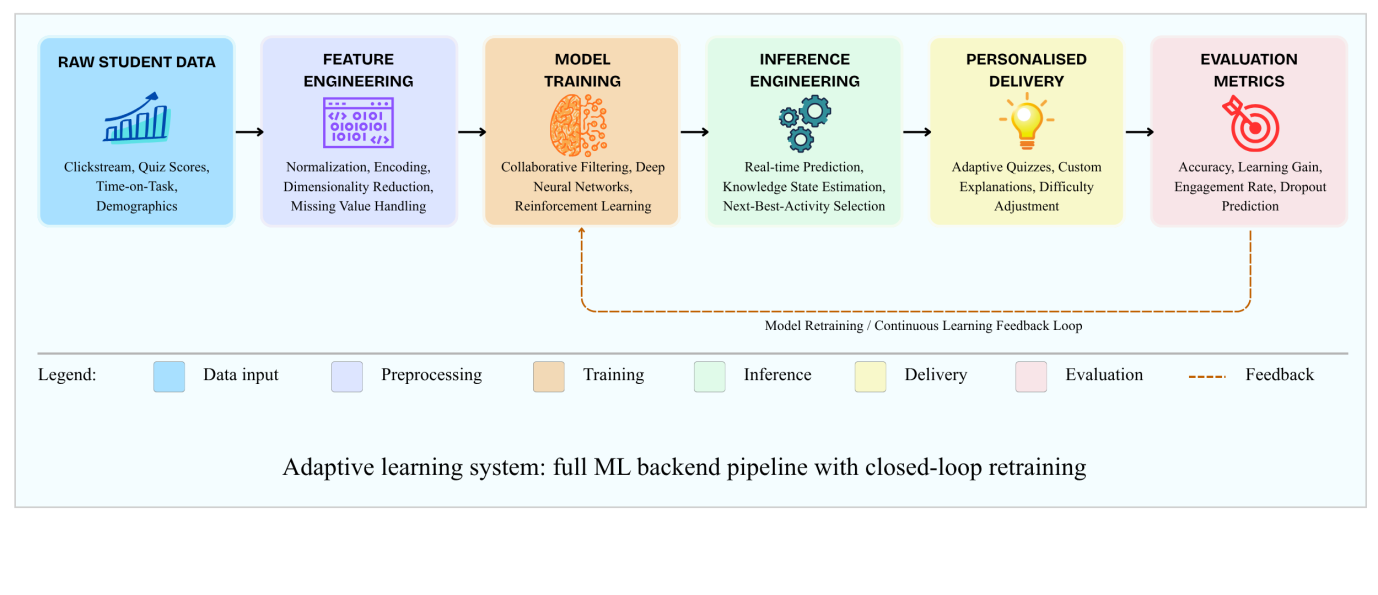
The following steps describe the general process of how such a system typically functions:
1) Data Collection:
Firstly, collecting data that includes students’ interaction logs, performance details, content interaction statistics, and occasionally demographic information is done. The data collected from the student is used in the training process and is continuously collected [1].
2) Model Training:
The collected data is used for training the machine learning model ahead of time. Developers will train the model ahead of time, and for Generative AI, specifically on datasets containing educational data. This will help the model comprehend the vocabularies and questions asked in the particular subject [5], [9].
3) Content Generation:
The model can now generate content from a prompt once it has been trained. When a student asks the model for an explanation or a practice question, it uses learned patterns to generate a response accordingly.
4) Personalisation Engine:
Reinforcement learning or rule-based logic used to make decisions about which content should be displayed next using the personalization engine [4].
5) Evaluation & Feedback Loop:
The final component in this process is evaluating the outcomes based on performance. Based on student performance, this will be fed into the system to fine-tune the model further. As time goes on, the system will learn to predict what each user needs [6].
- Why Educational Institutions are Adopting These Technologies?
There are several factors responsible for the sudden spike in interest in Generative AI technology by universities, schools, and edtech firms. The most crucial factor, perhaps, is the need for personalized solutions that can meet their individual needs. According to numerous studies, personalized instruction enables students to learn efficiently and provide them with a comfortable learning environment while keeping them engaged in the process [4]. Such personalized learning experience cannot be created manually and thus technology like Gen-AI comes into play. Scalability is another very important factor that pushes institutions towards adopting such solutions. As online learning becomes increasingly widespread and available across the globe, it becomes more necessary to develop scalable solutions which are able to manage thousands of learners simultaneously. The coronavirus pandemic had a significant impact on this trend, as the lockdown led to many institutions shutting down their doors. The emergence of Gen-AI in the post-COVID era became a necessity for many. Studies have proven that there has been a noticeable increase in adoption of Gen-AI in recent times.
According to UNESCO Global Education Monitoring Report, digital technologies such as artificial intelligence are now being viewed as the means through which education can be delivered in a manner that ensures equity, especially for students who may be located in distant regions or with physical conditions that may make learning hard. For tech companies that deal with education technology, this also presented a significant business opportunity. AI-enabled tutor robots such as the Khanmigo robot offered by Khan Academy offer students support throughout their day and walk them through solving STEM equations step by step..
- Advantages of Generative AI and Smart Learning Systems
Many distinct advantages arise from incorporating these technologies into teaching.
i. Personalization. The students receive personalized learning opportunities that are specifically tailored to their individual learning needs instead of the general approaches that need adaptation to fit every learner. Adaptive learning has been proven to improve learners’ academic results, especially among underperforming students or disadvantaged groups [4].
ii. Availability. Since generative artificial intelligence tools are readily accessible at any time and can even learn through practice, this provides a massive advantage to those students living across different geographical locations or unable to participate in traditional face-to-face classes. Having constant access to the tutors enables learners to seek assistance at any point of their studies.
iii. Workload reduction. From the perspective of educators and educational institutions, integrating these tools lowers their workload. Automation of various processes, such as content creation or grading tasks, saves a considerable amount of time, allowing teachers to dedicate themselves to mentoring or other high-level learning practices [6].
iv. Engagement. AI tutors encourage learner engagement by offering interactive and fun learning paths alongside real-time feedback. Studies have established that adaptive learning systems improve engagement and promote material comprehension [6].
- Challenges and Ethical Concerns
While highlighting all these benefits, we must acknowledge some other serious issues that arise when discussing the implementation of Generative AI in the educational environment.
- Privacy and Data Protection Issues:
In order to make smart learning systems work efficiently, vast amounts of sensitive data on the students’ achievements and behaviour should be collected. The potential misuse of such information may have severe implications. Therefore, it is necessary to ensure appropriate safeguards for personal information [10].
- AI System Biases:
Any generative AI model is created based on the input data set. If such a data set includes any biases, the AI model will replicate them. For example, content biases may relate to the cultural relevance of materials. The lack of diversity in the training data may lead to the creation of biased models. Addressing these problems requires further investigation [7], [9].
- Over Reliance on Technology:
Another issue that needs addressing in the field of pedagogy is the risk of students developing an over-reliance on such technologies. It would lead to them developing fewer problem-solving skills and knowledge. If a student always relies on an AI to explain certain concepts and write summaries of texts, they won’t acquire the required level of understanding since it doesn’t develop independently from other activities.
- Academic Integrity Issues:
One of the most significant issues to consider in practical terms is the question of academic integrity. Generative AI tools can be used by students for writing essays and completing other types of tasks, such as programming [10].
- Digital Divide:
As was mentioned earlier, one of the most prominent issues with modern society is the digital divide that separates people living in developed countries from those who don’t have good access to the Internet and modern devices. With the increasing reliance on AI in education, the divide will become even bigger [8].
Conclusion
It appears that generative AI and smart learning platforms represent a new wave in education that can bring much improvement. With personalized learning material, automated feedback, and intelligent tutoring that can be adjusted to the needs of each individual learner in real-time, the future of teaching and learning looks more optimistic. At the same time, one should not forget about problems with the privacy of student data and potential biases in learning algorithms. These troubling aspects call for immediate action by all parties involved, especially by educators and technology developers. In any case, the use of generative AI in education is only at its infancy and has many chances ahead of it. Being a Computer Science major student myself, familiar with the ins-and-outs of technologies like generative AI and using it in some cases for my studies, I find this topic exciting and interesting. The developments that are currently happening within the sphere will have a huge effect on the way people will acquire knowledge in the future. To my mind, it is crucial not to make Generative AI a substitute for studying itself but to use it as a supporting device.
References
- C. Romero and S. Ventura, “Educational data mining: A review of the state of the art,” IEEE Trans. Syst., Man, Cybern. C, vol. 40, no. 6, pp. 601–618, Nov. 2010.
- OpenAI, J. Achiam et al., “GPT-4 Technical Report,” arXiv preprint arXiv:2303.08774, Mar. 2023. [Online]. Available: https://arxiv.org/abs/2303.08774
- A. Ayushi, S. Kumar, S. K. Singh, S. P. Singh, P. Rai, K. T. Chui, and B. B. Gupta, “Neural network architectures for machine translation: Enhancing quality education through improved access to multilingual resources,” in Proc. Int. Conf. Soft Computing and its Engineering Applications, 2024.
- P. Brusilovsky and E. Millán, “User models for adaptive hypermedia and adaptive educational systems,” in Lecture Notes in Computer Science, vol. 4321, Springer, 2007, pp. 3–53.
- G. Mengi, S. K. Singh, S. Kumar, D. Mahto, and A. Sharma, “Automated machine learning (AutoML): The future of computational intelligence,” in Proc. Int. Conf. Cyber Security, Privacy and Networking, 2021, pp. 309–317.
- K. VanLehn, “The relative effectiveness of human tutoring, intelligent tutoring systems, and other tutoring systems,” Educ. Psychol., vol. 46, no. 4, pp. 197–221, 2011.
- UNESCO, “Artificial Intelligence in Education: Challenges and Opportunities for Sustainable Development,” UNESCO Working Papers on Education Policy, no. 07, Paris, 2019. [Online]. Available: https://unesdoc.unesco.org/ark:/48223/pf0000366994
- OECD, “OECD Digital Education Outlook 2021: Pushing the Frontiers with Artificial Intelligence, Blockchain and Robots,” OECD Publishing, Paris, 2021. doi: 10.1787/589b283f-en
- S. Kumar, S. K. Singh, and L. Nelson, “Computational intelligence in decision support: Scope and techniques,” in Uncertainty in Computational Intelligence-Based Decision Making, 2025, pp. 219–238.
- A. Pardo and G. Siemens, “Ethical and privacy principles for learning analytics,” Br. J. Educ. Technol., vol. 45, no. 3, pp. 438–450, 2014. doi: 10.1111/bjet.12152
- Wang, Y., Mo, D. Y., & Ho, G. T. S. (2023). How Choice Fatigue Affects Consumer Decision Making in Online Shopping. In 2023 IEEE International Conference on Industrial Engineering and Engineering Management (IEEM), USA, pp. 0128-0132.
- Ho, G. T. S., Tang, Y. M., Tsang, K. Y., Tang, V., & Chau, K. Y. (2021), “A blockchain-based system to enhance aircraft parts traceability and trackability for inventory management”, Expert Systems with Applications, 179, 115101
- Gupta, B. B., Gaurav, A., & Panigrahi, P. K. (2023). Analysis of the development of sustainable entrepreneurship practices through knowledge and smart innovative based education system. International Entrepreneurship and Management Journal, 19(2), 923-940.
- Arya, V., Gaurav, A., Gupta, B. B., & Chui, K. T. (2024). A bibliometric analysis of environmental education and sustainable entrepreneurship development in a global perspective. Sustainable Technology and Entrepreneurship, 3(3), 100080.
Cite As
Bhavya (2026) Generative AI and Smart Learning Systems for Enhancing Educational Outcomes, Insights2Techinfo, pp.1