


By: – Abhay Pratap Singh, co23306@ccet.ac.in
Abstract
The evolution of mobile hardware has transformed smartphones from mere communication devices into high-performance computing platforms capable of executing complex security evaluations. This article explores the conversion of rooted Android devices into portable cyber labs by leveraging Linux environments like Kali NetHunter and Termux, integrated with cutting-edge Large Language Models (LLMs) for automated exploitation. We analyze the technical architecture of Android rooting, the “arms race” between detection and evasion, and the emerging role of AI in streamlining penetration testing workflows. By synthesizing recent research, we provide a comprehensive guide to mobile reconnaissance, Wi-Fi auditing, and the ethical considerations of deploying “pocket hacking” tools in the modern threat landscape.
Keywords: Android Rooting, Kali NetHunter, AI-Powered Pentesting, Mobile Security, PentestGPT, Cyber Labs, Ethical Hacking.
1.Introduction
The dominant player on today’s mobile market is the Android platform that covers approximately 70% to 73% of total market share. According to recent statistics, at least 52.8% of people with smartphones choose Android-oriented operating systems. In this regard, the current mobile market reflects an increasing trend in security threats, especially aimed at targeted attacks on OS-level features. Moreover, modern smartphone capabilities have evolved to a level at which the device has turned into a powerful “pocket computer” equipped with processor performance on par with typical laptops.

The transition between regular usage and advanced operations is marked by the search for privileges. “Knowledgeable users” no longer view the Android operating system merely as a tool for everyday use but as an opportunity to use all capabilities provided by the hardware platform. This article is focused on the discussion of technical aspects of pocket hacking from basic privilege escalation and the use of custom kernels to advanced penetration testing on Kali NetHunter.
2. Android Security Architecture
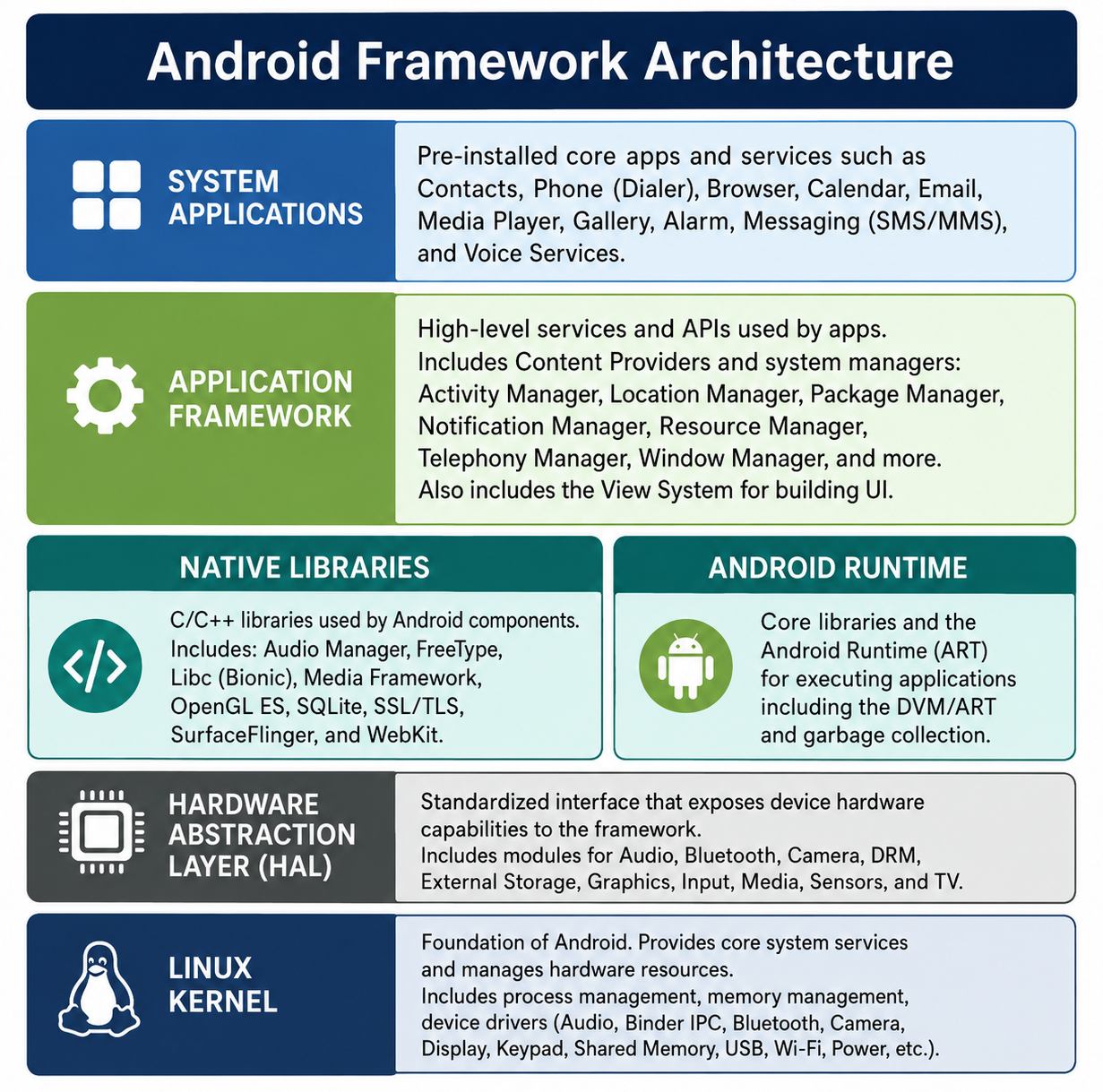
Security protection in Android is implemented by means of a multi-layer architecture that isolates individual processes and creates barriers to intrusion from the lowest levels of system functionality [12]. First of all, it includes the Linux Kernel that provides hardware driver functionality and additional security mechanisms and contains hardware-based applications [6]. Second, there is the Hardware Abstraction Layer (HAL), which plays a key role in connecting software to particular hardware elements such as sensor or the camera module [6].
In this sense, the system relies on the sandbox principle by implementing a robust isolation system, which involves assigning separate POSIT User IDs to every application running on the platform [4][8]. In addition, Android employs Paranoid Networks by hard-coding group IDs to the kernel, thus restricting the ability to create socket connections to certain processes [8]. All mentioned measures ranging from Google Play runtime checks to the sandbox implemented on the kernel level provide necessary protection from privilege escalation [13].
3. Android Rooting and Privilege Escalation
Rooting is associated with the ability to escalate privileges to the highest level of Android hierarchy, specifically to UID 0, which is usually blocked in userland to prevent total access to system functionality [4][8]. This operation gives an advantage to the user by allowing to get rid of vendor-added features, create a full backup copy, and even change system kernels and ROMs [4][6]. Custom kernel, in turn, is the modified version of stock Linux that uses the device’s hardware to the fullest extent by adjusting voltage parameters and overclocking [6].
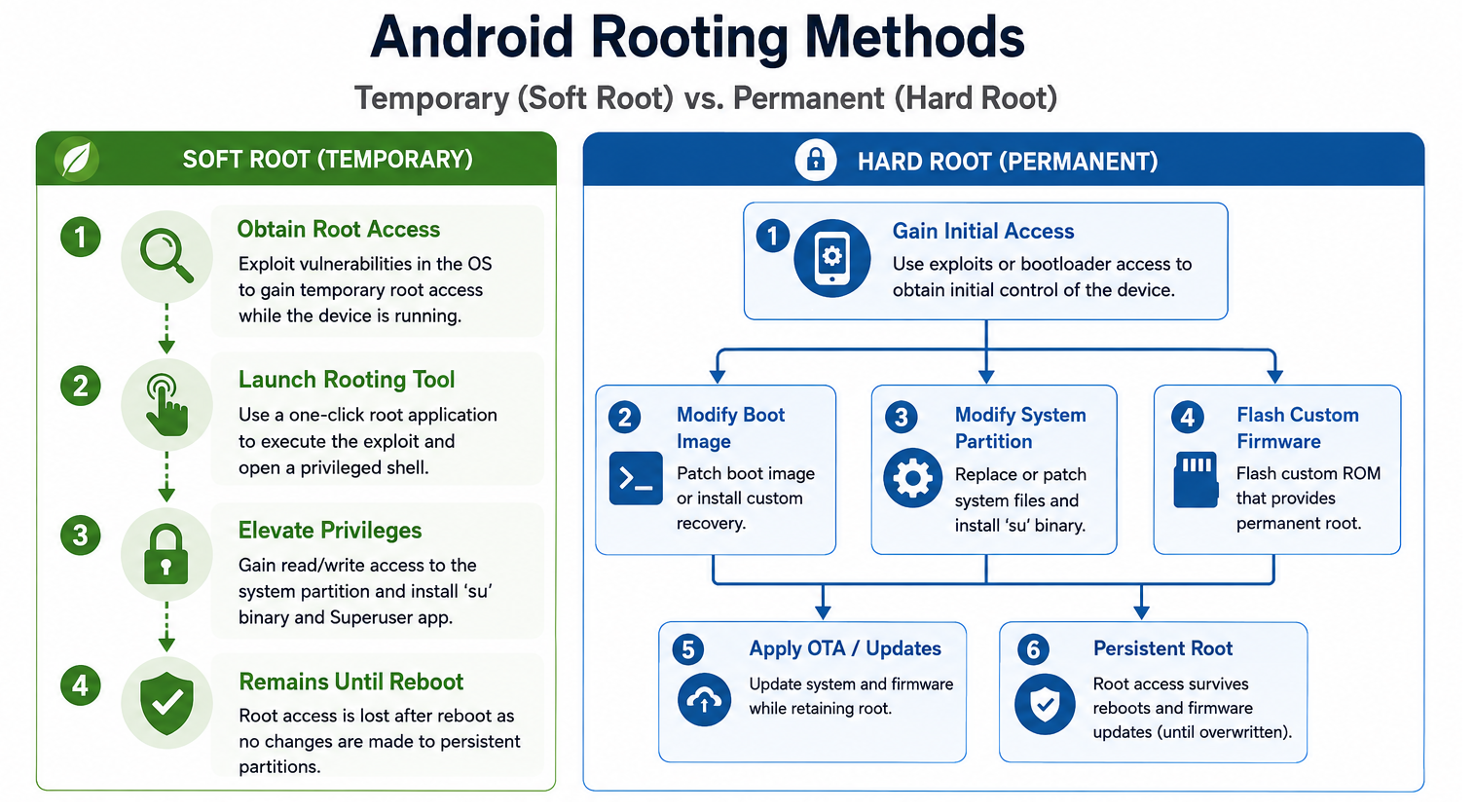
According to the existing categorization, there are two types of rooting, known as Soft Root and Hard Root [4]. Soft rooting exploits software-based vulnerabilities in the kernel, such as Dirty COW, to temporarily gain root shell privileges [4][8]. Conversely, the hard method of rooting involves interaction with the smartphone physically and requires such steps as unlocking a bootloader in fastboot mode followed by flashing a custom TWRP recovery to install su binary and such rooting managers as Magisk or SuperSU [14].
4. Root Detection and Evasion
The growing number of rooting operations has launched an asymmetric war between modules dedicated to detecting tampering and tools developed to evade them [4]. Among common methods employed by banking and financial applications are the searches for certain files or system property keys that include su binary, Build Tag test-keys or System Properties ro.debuggable [1][4]. Besides, advanced rooting modules also scan the list of package names for such programs as com.noshufou.android.su or de.robv.android.xposed.installer [4].
To avoid these operations, one may employ rooting evasion frameworks that use API hooking to return fake results to queries sent from the module [4]. For example, RootCloak can replace the output of any call for File.exists() method with fake result when trying to locate such files as chainfire or superuser [4]. Moreover, nowadays even more covert techniques for root detection have been invented that involve using side-channels to analyze time parameters. Specifically, researches show that the average time taken for a DNS PTR request varies significantly on rooted devices [1].
5. Kali Linux and Kali NetHunter
Kali NetHunter is the ultimate mobile pentesting environment that consists of the Kali Linux system running over the top of Android hardware [9]. There are several variants of NetHunter including NetHunter Rootless (for unrooted devices), NetHunter Lite (requires root access), and NetHunter (uses a special kernel). NetHunter Lite version allows users to deploy various services, such as Metasploit Payload Generator, MAC Changer, and DuckHunter HID attacks [9]. Hence, a smartphone can serve as a potent attack vector to disrupt a company’s whole network using SlowDroid DoS attack [9].
However, these actions leave traces that are easy to find using forensic analysis that reveals stored artifacts in \data\local\nhsystem and .zsh_history files that store target IP and sequence of commands executed during the process [9].
6. Termux and Portable Linux Environments
Portable Linux environments allow turning any smartphone into a mobile laptop due to the possibility to manipulate system parameters and even revamp OS features [5]. While Android is limited to a set of capabilities provided by a vendor, these environments let advanced users perform more operations, such as installing custom kernels that can be tailored to work better with hardware by altering I/O Scheduler and TCP Congestion Algorithm [15].
7. AI-Powered Penetration Testing
Modern technology trends include the introduction of artificial intelligence (AI) and large language models (LLM) into the sphere of automated pen-testing [2][5]. Such platforms as PentestGPT and VulnBot can generate runnable Python and ADB scripts with just one iteration of the conversation [5]. As a result, LLM-powered systems can quickly exploit vulnerabilities, even such newly detected bugs that are referred to as “one-day vulnerabilities” [5].
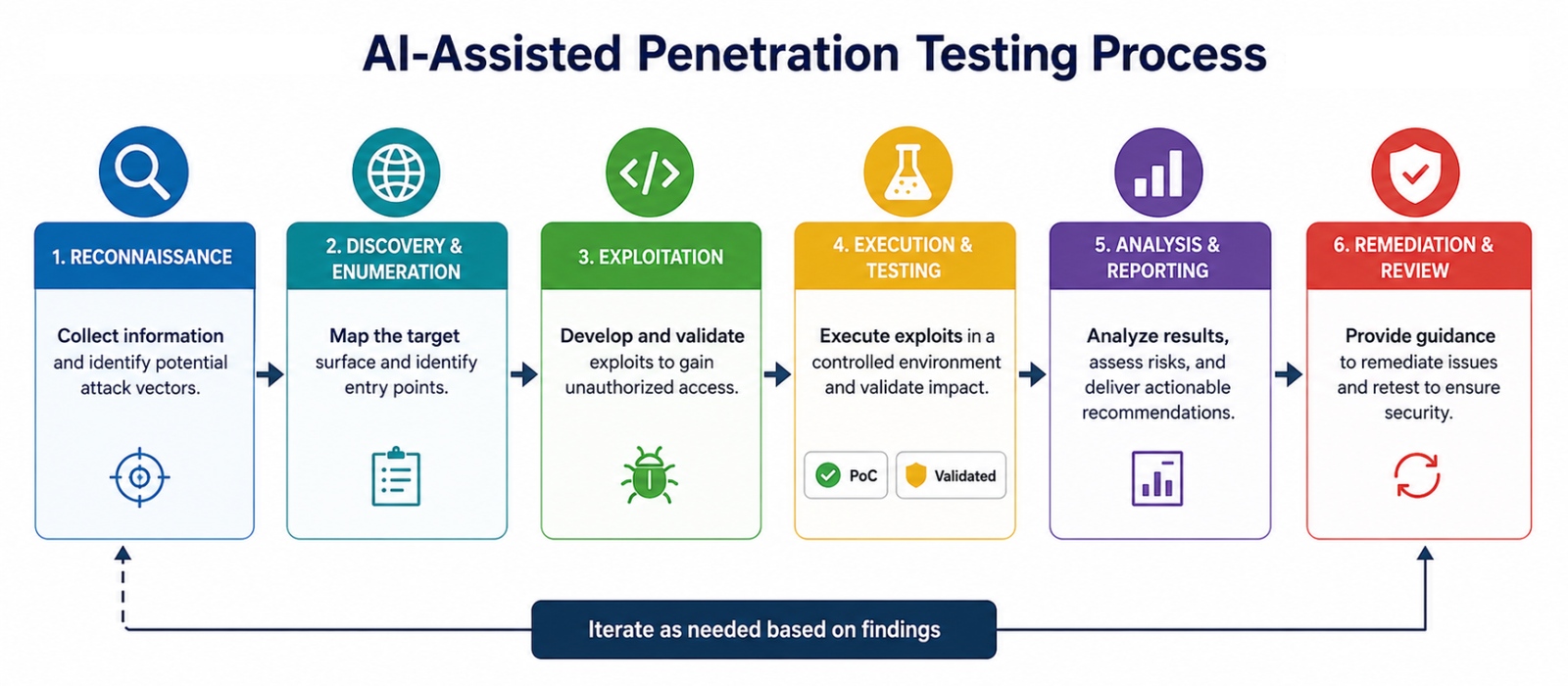
According to current scientific research, more than 77% of all AI applications in pentesting are focused on Reinforcement Learning (RL), which is useful in case of unknown topology of network [2]. In order to ensure the security of future systems based on AI, researchers have suggested implementing post-quantum AI solutions that would combine the functions of IAST monitoring and RLWE encryption [7].
8. Accessibility-Service Exploitation
Accessibility service is another technique used for the silent installation of malicious packages in Android-based mobile platforms [10]. Thanks to accessibility helpers, such as AccessibilityNodeInfo class, an attacker can easily identify UI controls and execute “clicks” on buttons Install, OK, and Next [10]. As a result, the operation does not need to have root privileges, which makes it almost undetectable even by antivirus systems [10]. Using this approach, a regular flashlight app can be transformed into a penetration tool capable of loading Metasploit payload via Smali code alteration and decompilation [10].
9. Mobile Reconnaissance and Wi-Fi Auditing
Apart from being part of a wireless network, mobile phones can perform thorough auditing of its participants [9]. In particular, with the help of the USB Arsenal and MAC Changer feature of Kali NetHunter, it is possible to impersonate another person and bypass authorization in the network [9]. Further, it is possible to use Nmap to perform reconnaissance by identifying connected devices and the corresponding ports opened for connections [1]. Remote root detection techniques can also be implemented to identify vulnerable systems in hotspot by measuring the standard deviation of response time to DNS PTR query [1].
10. Digital Forensics and Rootkit Detection
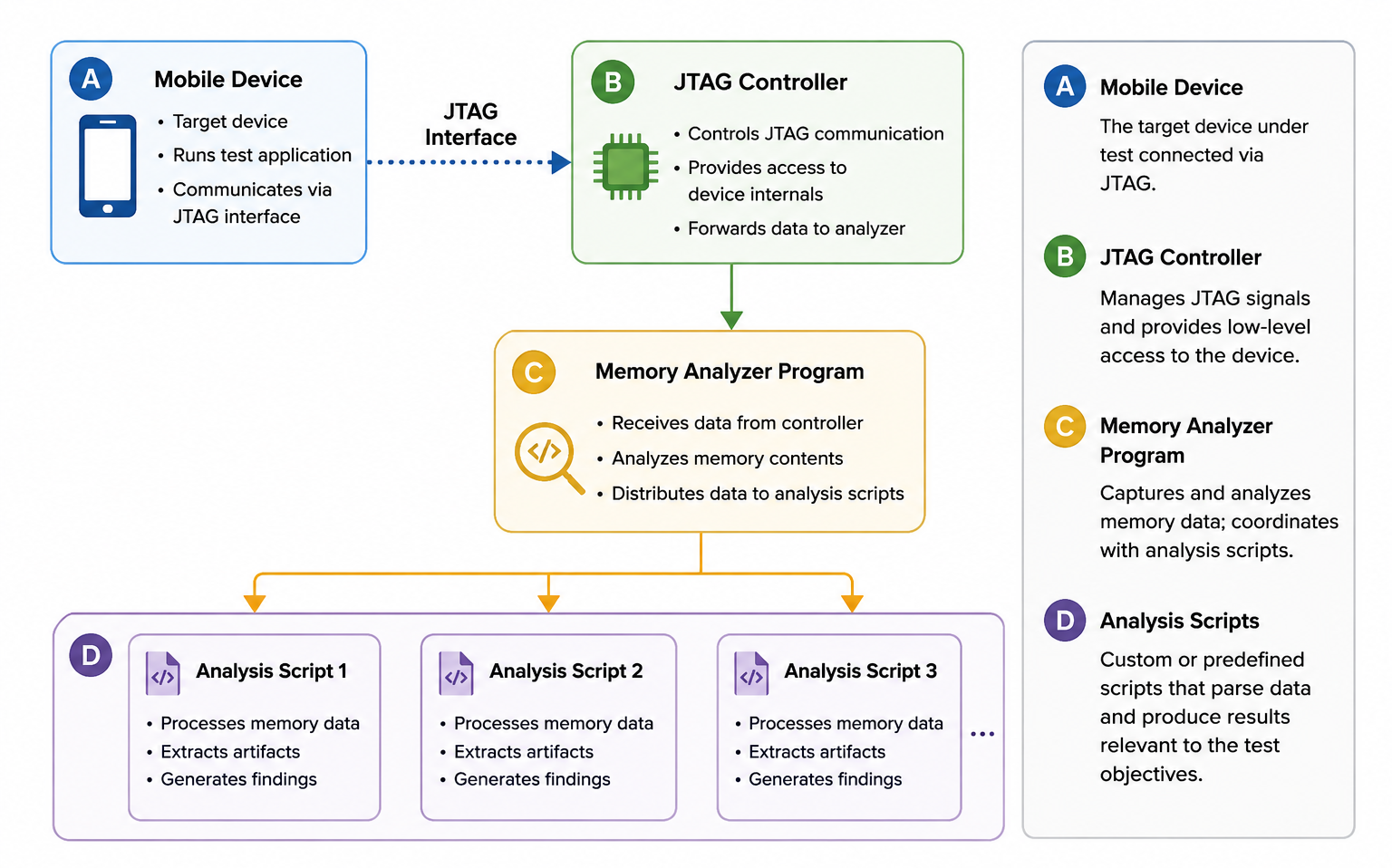
The migration of malware to the kernel space makes software solutions useless since they might be easily circumvented by rootkits [3]. As an alternative approach, one may use the hardware-based solution named JoKER (Joint Test Action Group observation of Kernel), which captures the trusted snapshot of device memory via JTAG port [3]. Such a mechanism enables to detect Oldboot-style bootkits and DKOM (Direct Kernel Object Manipulation) attacks when a process is hidden from the kernel’s own list of processes [3].
To conduct successful investigation, one should acquire a physical dump of the phone’s memory. Artifacts should be looked for in folders like \data\media\0\nh_files and database tables called KalisServicesFragment [9]. The final stage involves comparing the list of active processes retrieved from the memory dump with those reconstructed from kernel cache pool [3].
11. Android vs iOS Pentesting
One of the crucial issues concerning security assessment of modern mobile devices is rooted in their different architectural principles [11]. Due to the open-source nature of Android, one is able to explore system components deeply with help of rooting tools, frida, and objection [11]. In contrast, iOS is characterized by completely opposite principles, as the system works with hardware’s Secure Enclave and implements a highly coordinated secure boot process [11]. Therefore, in order to assess iOS’ weaknesses, jailbreaks are the primary method employed [11]. Yet, this practice may face numerous ethical concerns that may be somewhat eased via such measures as SRD program introduced by Apple [11].
12. Ethical and Legal Considerations
Despite the benefits rooting and mobile hacking brings to the user, he/she is taking responsibility for the device’s CIA triad (Confidentiality, Integrity, and Availability) in case he/she roots the phone since such action voids warranty and increases the chances of getting bricked [16]. Additionally, the implementation of AI-driven systems poses extra demands to control their use and limit the damage done. Namely, the use of such a solution requires constant human supervision when developing the script [5]. As for legislation, it is essential to introduce certain rules concerning ethical hackers since many countries require to report any cyber breach [11].
13. Future of AI-Driven Cybersecurity
Looking into the future, it is necessary to pay attention to the emergence of collaborative AI pentesting systems capable of performing all stages of exploitation [17]. Some of them, such as PenBox (created by the European Space Agency) and PenHeal platforms have already shown promising results by providing fully-automated tests and subsequent detailed reports [2]. As for the problem of quantum decryption, it requires embedding of lattice-based encryption and Ring Learning With Error (RLWE) in AI pentesting platforms [7].
14. Conclusion
Pocket hacking has transformed from simple privilege escalation to much broader domain that includes AI-driven automation, kernel analysis, and cross-platform auditing. While the war between rooting evasion frameworks and detection modules remains an asymmetric competition due to the constantly changing conditions, the development of kernel-based checks and JTAG-based forensics provides means for trustworthy security verification.
15. References
- Bialon, R. (2020). On Root Detection Strategies for Android Devices (arXiv:2012.01812). arXiv. https://doi.org/10.48550/arXiv.2012.01812
- Curtis, J. A., & Eisty, N. U. (2025). The Role of AI in Modern Penetration Testing (arXiv:2512.12326). arXiv. https://doi.org/10.48550/arXiv.2512.12326
- Guri, M., Poliak, Y., Shapira, B., & Elovici, Y. (2015). JoKER: Trusted Detection of Kernel Rootkits in Android Devices via JTAG Interface. 2015 IEEE Trustcom/BigDataSE/ISPA, 65–73. https://doi.org/10.1109/Trustcom.2015.358
- Nguyen Vu, L., Chau, N.-T., Kang, S., & Jung, S. (2017). Android Rooting: An Arms Race between Evasion and Detection. Security and Communication Networks, 2017, 1–13. https://doi.org/10.1155/2017/4121765
- Perera, W. V. I., Liu, X., Liang, F., & Zhang, J. (2025). Breaking Android with AI: A Deep Dive into LLM-Powered Exploitation (arXiv:2509.07933). arXiv. https://doi.org/10.48550/arXiv.2509.07933
- Rahimi, N., Nolen, J., & Gupta, B. (2019). Android Security and Its Rooting—A Possible Improvement of Its Security Architecture. Journal of Information Security, 10(2), 91–102. https://doi.org/10.4236/jis.2019.102005
- Radanliev, P. (2025). Collaborative Penetration Testing Suite for Emerging Generative AI Algorithms. Applied Intelligence, 55(16), 1030. https://doi.org/10.1007/s10489-025-06908-1
- Shabtai, A., Fledel, Y., Kanonov, U., Elovici, Y., & Dolev, S. (2009). Google Android: A State-of-the-Art Review of Security Mechanisms (arXiv:0912.5101). arXiv. https://doi.org/10.48550/arXiv.0912.5101
- Stanković, M., & Karabiyik, U. (2022). Exploratory Study on Kali NetHunter Lite: A Digital Forensics Approach. Journal of Cybersecurity and Privacy, 2(3), 750–763. https://doi.org/10.3390/jcp2030038
- Sun, H., Jin, C., Helu, X., Lu, H., Zhang, M., & Tian, Z. (2020). Research on Android Infiltration Technology Based on the Silent Installation of an Accessibility Service. International Journal of Distributed Sensor Networks, 16, 155014772090362. https://doi.org/10.1177/1550147720903628
- Tinuoye, A. P. (2025). Evaluating Penetration Testing Methodologies for Mobile Applications: A Comparative Study of Android and iOS Security (SSRN Scholarly Paper No. 5384360). Social Science Research Network. https://doi.org/10.2139/ssrn.5384360
- Sharma, A., Singh, S.K., Kumar, S., Chhabra, A., Gupta, S. (2023). Security of Android Banking Mobile Apps: Challenges and Opportunities. In: Nedjah, N., Martínez Pérez, G., Gupta, B.B. (eds) International Conference on Cyber Security, Privacy and Networking (ICSPN 2022). ICSPN 2021. Lecture Notes in Networks and Systems, vol 599. Springer, Cham. https://doi.org/10.1007/978-3-031-22018-0_39
- Mishra, A., Kumar, S., Singh, S. K., Bhattarai, D., Chhabra, A., Gill, S. S., Arya, V., & Jain, A. (2025). Future Trends in AI-Driven Green Computing and Security. In Sustainable Information Security in the Age of AI and Green Computing (pp. 39–72). IGI Global Scientific Publishing. https://doi.org/10.4018/979-8-3693-8034-5.ch003
- Singh, S., Kumar, S., Singh, M., Gupta, S., Attar, R., Arya, V., Alhomoud, A., & Gupta, B. B. (2025). Quantum-Resistant Cryptographic Primitives Using Modular Hash Learning Algorithms for Enhanced SCADA System Security. Computers, Materials & Continua, 84, 3927–3941. https://doi.org/10.32604/cmc.2025.059643
- Rajput, D., Singh, S. K., Kumar, S., Vashisht, H., Chui, K. T., & Gupta, B. B. (2024). SentinelMet: Enhancing Metaverse Security through Deep Learning Techniques in 6G. 2024 IEEE International Conference on Advanced Networks and Telecommunications Systems (ANTS), 1–6. https://doi.org/10.1109/ANTS63515.2024.10898831
- Kumar, R., Kumar, S., Singh, S. K., Rawat, Y., Han, C., Gupta, B. B., Nedjah, N., & Jain, A. (2025). AI-Driven Green Computing for Sustainable Information Security. In Sustainable Information Security in the Age of AI and Green Computing (pp. 99–126). IGI Global Scientific Publishing. https://doi.org/10.4018/979-8-3693-8034-5.ch005
- Singh, T., Kumar, S., Singh, S. K., Priyanshu, Gupta, B. B., Wu, J., & Castiglione, A. (2025). Enhancing Autonomous System Security With AI and Secure Computation Technologies. In AI Developments for Industrial Robotics and Intelligent Drones (pp. 159–186). IGI Global Scientific Publishing. https://doi.org/10.4018/979-8-3693-2707-4.ch008
- Sharma, K., & Gupta, B. B. (2019). Towards privacy risk analysis in android applications using machine learning approaches. International Journal of E-Services and Mobile Applications (IJESMA), 11(2), 1-21.
- R. B., M., Tiwari, H., & Verma C., D. (2022). Resource Optimization in Cloud Data Centers Using Particle Swarm Optimization. International Journal of Cloud Applications and Computing (IJCAC), 12(2), 1-12. https://doi.org/10.4018/IJCAC.305856
- Mounish K.V.S. (2024) Cyber security and Biometrics: Machine Learning Solutions, Insigts2Techinfo, pp.1; https://insights2techinfo.com/cyber-security-and-biometrics-machine-learning-solutions/
Cite As
Singh A.P. (2026) Pocket Hacking: From Root Access to Kali Linux, Insights2Techinfo, pp.1