


By; Brij B Gupta, Asia University
Smart cities use many technologies and data systems to make urban life, operations, and sustainability better. Nonetheless, this enhanced connectivity creates a more intricate and expanding attack surface for cybercriminals. The focus of this article is on how the threats to smart cities have evolved from hacking information to hacking critical physical infrastructure. Analyzing the trend towards complex multi-stage operations targeting Internet of Things (IoT) devices, industrial control systems and inter-connected municipal services. An examination of upcoming trends as well as existing major weaknesses shows that robust and adaptive security frameworks will be needed to safeguard the physical and cyber integrity of the mart.
Introduction
The smart city concept has quickly gone from vision to reality all over the world. Cities aim to improve resource management and citizen engagement by applying information and communication technology (ICT) to physical infrastructure [1,2]. This type of integration employs a multitude or wide range of sensors, actuators, as well as communication protocols to analyze or collect data. Technological developments benefit us greatly, but also impose unique security risks. The systems that enable smart cities to function are closely interlinked. Thus, a single security issue in one part can affect the whole city [3,4].
According to [5,6], in past years, the quality of cyber attacks has changed from basic data breach to complex operation targeting critical infrastructure. In a smart city, the stakes are severely elevated as cyber attacks can lead to a physical disruption of services, economic loss, and human life threats. It is vital for urban planners, policy-makers, and security professionals to understand how these attacks are changing to safeguard modern cities’ digital and physical integrity.
The Evolution of Cyber Threats in Smart Cities
Cyber threats urban areas have gone through various stages. The initial goal of the attacks was to steal data and commit financial fraud in municipal administrations [7]. Hackers are now eyeing Operational Technology (OT) with the emergence of the Industrial Internet of Things (IIoT)[8]. This change marks the transition from digital to cyber-physical attacks.
Today’s cyber-attacks in smart cities are characterized by sophisticated persistence. APTs, or advanced persistent threats, are used by actors to gain long-term access to the networks of St. Petersburg. Perpetrators will conduct reconnaissance and wait for the right time to strike. Additionally, cybercriminals are utilizing automation tools and artificial intelligence. As a result, it has become increasingly difficult for manual detection and response mechanisms to keep up with this increase in scale and speed.
The rapid urbanisation and usage of Internet of Things (IoT) are the core for smart cities[10]. In spite of the fact that they offer the hope of more efficiency, sustainability and quality of life, they also pose new cybersecurity threats. As urban systems begin to link with one another, the nature of cyber attacks is also changing from data leak to multi-vector attack on physical systems. The article examines the evolving cyber threat landscape in smart cities and identifies specific vulnerabilities in the increasingly interconnected urban ecosystem. The shift is from purely digital disruptions to cyber-physical attacks which damage public safety, energy grids and transportation networks. The report also looks at new mitigation strategies while urging resilient, security-by-design approaches to save the future of cities.
Key Vulnerabilities in Smart Infrastructure
The smart city infrastructure is exposed to a number of dangers. To begin with, legacy systems used in utility sectors such as water and electricity do not have cybersecurity design expectations. When connected to the internet to provide “smart” functionality, these systems are often not equipped with strong authentication and encryption.
The multitude of devices IoT now offers a big attack surface. As per experts, these devices are low power devices with limited computing capabilities, making the robust implementations hard. The diverse supply chain for these types of devices means that the security standards differ from one manufacturer to the other and that backdoors or unpatched vulnerability exists [10-12].
Common vulnerabilities include:
- Insecure Communication: Lack of encryption between sensors and central control systems.
- Weak Authentication: Use of default passwords and lack of multi-factor authentication for critical systems.
- Software Vulnerabilities: Unpatched software and firmware in embedded devices.
- Physical Access: Sensors and actuators located in public spaces are susceptible to physical tampering.
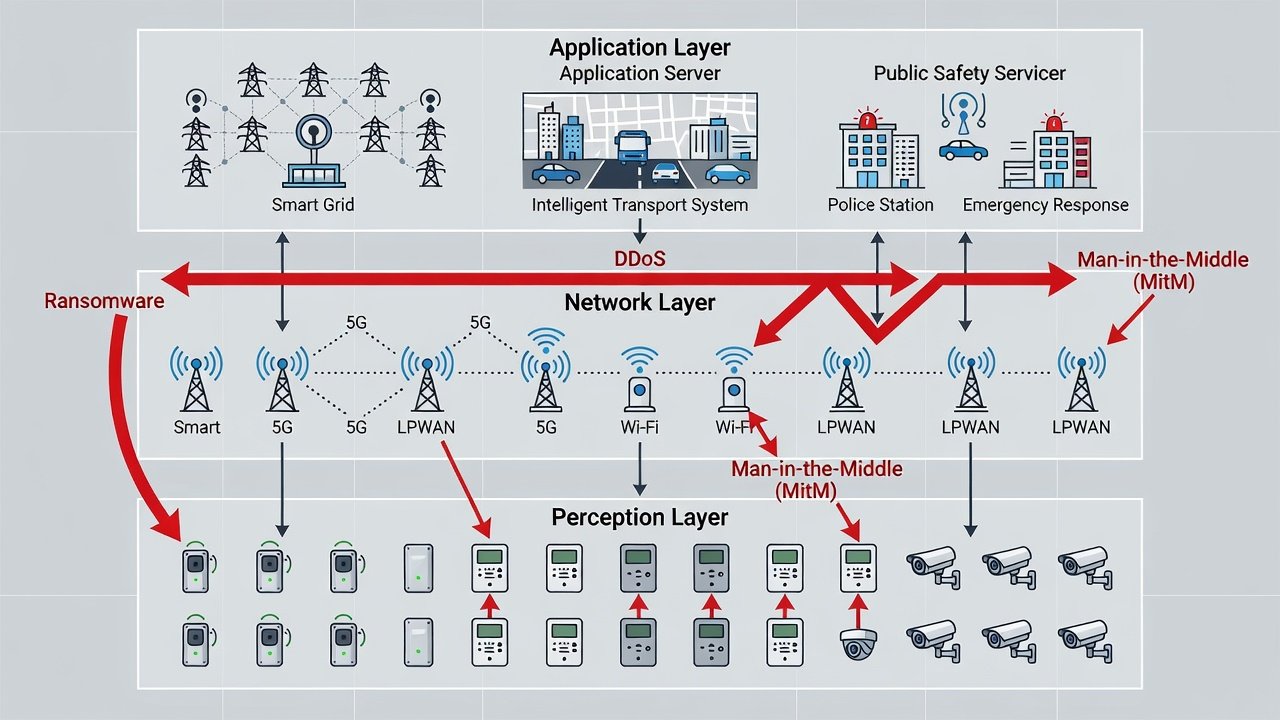
Comparison of Attack Types
Table 1 compares traditional cyber attacks with those specifically targeting smart city environments.
Feature | Traditional Cyber Attacks | Smart City Cyber Attacks |
Primary Target | Data and Financial Assets | Critical Infrastructure and Public Services |
Impact | Information Loss, Financial Theft | Physical Disruption, Safety Risks, Social Unrest |
Attack Surface | Enterprise Networks, Personal Devices | IoT Devices, Sensors, Industrial Control Systems |
Complexity | Variable (Low to High) | High (Multi-vector and Cross-domain) |
Recovery Time | Minutes to Days | Days to Weeks (Physical repairs may be needed) |
Mitigation Strategies and Future Outlook
To combat this evolving threat, smart cities must address their cyber-defenses in a comprehensive manner. The infrastructure must be developed using “security by design” principles to ensure that security is built-in at every stage of development.
Key strategies include:
- Network Segmentation: Isolating critical infrastructure networks from public-facing systems to prevent lateral movement by attackers.
- Continuous Monitoring: Using AI-driven Security Operations Centers (SOCs) to detect anomalies and respond to threats in real-time.
- Standardization: Developing and enforcing unified security standards for IoT devices and communication protocols .
- Public-Private Partnerships: Collaboration between government agencies, technology providers, and academic institutions to share threat intelligence and best practices.
The future potential for smart city data security enhancement could be provided by the use of blockchain technology and quantum-resistant encryption. As technology continues to advance, cybercriminals will also adapt their tactics, which requires urban defense to innovate and change constantly.
References
- Anthopoulos, L. G. (2026). The rise of the smart city. In Understanding smart cities: A tool for smart government or an industrial trick? (pp. 5-55). Cham: Springer Nature Switzerland.
- Abdelghany, M. B., Shafiqurrahman, A., Al-Durra, A., Mohamed, M., Hu, J., Vaccaro, A., … & El Moursi, M. S. (2026). Hydrogen energy systems for decarbonizing smart cities and industrial applications: A review. Renewable and Sustainable Energy Reviews, 226, 116370.
- Subramanian, R. S., Yuvasri, B., & Sudha, K. (2026). Blockchain Technology as a Foundation for Smart City Security: Enhancing Trust and Resilience. In Securing Smart Cities Through Modern Cryptography Technologies (pp. 263-286). IGI Global Scientific Publishing.
- Alnuaim, A. (2026). Intrusion Detection and Security Attacks Mitigation in Smart Cities with Integration of Human-Computer Interaction. Computers, Materials, & Continua, 86(1), 1.
- Mohapatra, A., Hota, A., Kushwaha, B. S., Dixit, M., Rajesh, U., & Swathika, O. G. (2026). Cyberattack on Smart Cities: A Digital Approach. Digital Cities, 497-534.
- Emon, M. M. H. (2026). Cybersecurity in the Smart City Era: Overcoming Challenges With Modern Cryptographic Solutions. In Securing Smart Cities Through Modern Cryptography Technologies (pp. 43-74). IGI Global Scientific Publishing.
- Demertzi, V., Demertzis, S., & Demertzis, K. (2023). An overview of cyber threats, attacks and countermeasures on the primary domains of smart cities. Applied Sciences, 13(2), 790.
- Peter, O., Pradhan, A., & Mbohwa, C. (2023). Industrial internet of things (IIoT): opportunities, challenges, and requirements in manufacturing businesses in emerging economies. Procedia Computer Science, 217, 856-865.
- Hejase, H. J., Fayyad-Kazan, H. F., & Moukadem, I. (2020). Advanced persistent threats (apt): an awareness review. Journal of Economics and Economic Education Research, 21(6), 1-8.
- Nassereddine, M., & Khang, A. (2024). Applications of Internet of Things (IoT) in smart cities. In Advanced IoT technologies and applications in the industry 4.0 digital economy (pp. 109-136). CRC Press.
- Tang, V., Choy, K. L., Ho, G. T. S., Lam, H. Y., & Tsang, Y. P. (2019), “An IoMT-based geriatric care management system for achieving smart health in nursing homes”, Industrial Management & Data Systems, vol. 119 no. 8, pp. 1819-1840.
- Karthik V. (2025) From Smart Cities to Cyber Battlegrounds : Securing Urban IoT Networks, Insights2techinfo pp.1, https://insights2techinfo.com/from-smart-cities-to-cyber-battlegrounds-securing-urban-iot-networks/
Cite As
Gupta B.B. (2026) How Cyber Attacks Are Changing in Smart Cities, Insights2Techinfo, pp.1