


By: Brij B. Gupta, Asia University
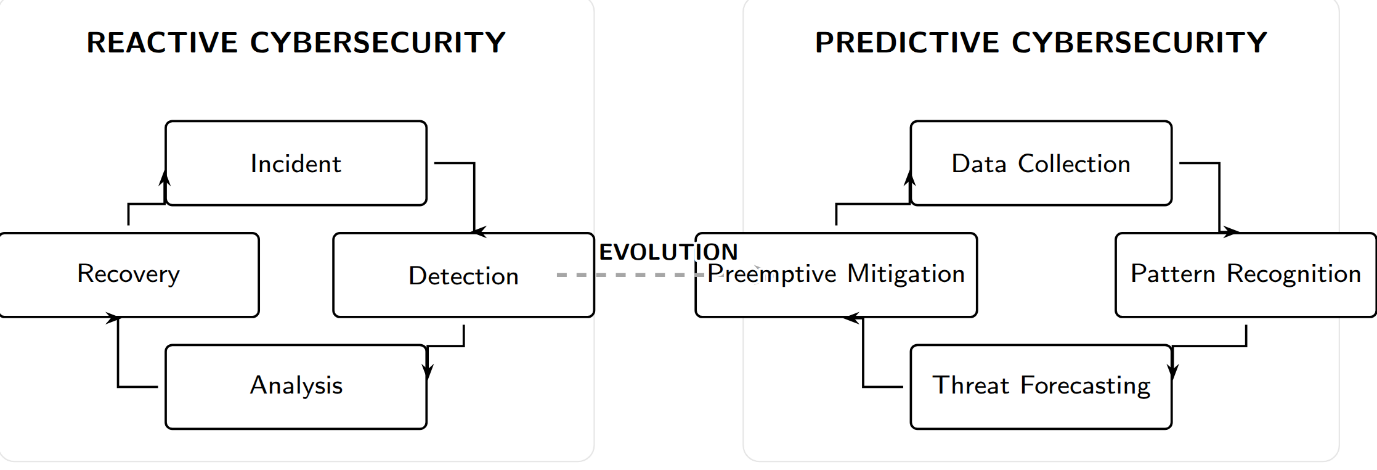
The cyberattacks are more elaborate and frequent than ever before, and relying on reactive security solutions will not suffice anymore. This article will look at the paradigm shift from reactive to predictive cyber-security. Organizations are capable of anticipating threats before they materialize, as well as neutralizing them, through artificial intelligence, machine learning and threat intelligence. Moving from recovery to prevention will mark the next step in digital defence evolution towards a predictive model.
Introduction
Since decades cybersecurity is mostly reactive [1] Organizations would install firewalls [2] and antivirus software [3] and would wait for an alert to go off. The rationale behind the “break-fix” mentality is that the attack must have succeeded or at least be detected in progress. Unfortunately, with cybercriminals using automated capabilities and zero-day exploits, the reaction time has been rendered practically nonexistent.
The reactive security model is indeed flawed data breaches are getting costly and APTs are still around [5]. The industry seeks a predictive security model to counter these evolving threats [6] . This effort is concerned with discovering patterns, weaknesses and intent before the actual occurrence of an incident so that it can be mitigated [7].
The Evolution of Cybersecurity Strategy
The process of evolving from reactive to predictive cybersecurity has maturity stages. In the beginning, security was passive and based on walls. As digital systems grew, it became reactive as per signature detection and incident response. We are now entering an era of prediction.
From Reactive to Proactive
Hunting for threats and hardening of systems based on what is known is proactive security [8]. While better than solely using historical methods, this still frequently relies on past data. Predictive security utilizes this information to model attack pathways which can happen in the future.
The Predictive Paradigm
Predictive cybersecurity [9,10] uses big data and behavioral analytics to create a “weather map” of the threat landscape. Instead of asking “What happened?”, security teams ask “What is likely to happen next?” and “Where are we most vulnerable right now?” .
Key Technologies Driving Predictive Defense
The shift to predictive security is powered by several converging technologies that allow for the processing of vast amounts of data in real-time.
• Artificial intelligence (AI) and machine learning (ML) [11] governs large volumes of security data to find unusual patterns and suspicious activity. Various technologies help to identify unusual patterns in network communications, system operations, and user operations which could go unnoticed through ordinary monitoring techniques.
• Threat intelligence platforms gather, organize, and analyze data from different security sources, such as threat feeds, security reports, and incident databases. This study material enables organizations to spot the latest trends in attacks, the vulnerabilities that are known and the customary conduct of adversaries.
• Data is continually monitored in a business environment through user and entity behavior analytics (UEBA) solutions to create a normal behavioral model for the user, device, or other entity. Unusual deviations from these patterns may indicate that an account has been hacked, a malicious action will be taking place, or even an insider threat. Early detection and response may help mitigate the risks involved.
Benefits and Challenges of Predictive Security
While the advantages of a predictive approach are significant, implementation is not without its hurdles.
Advantages
A decrease in the time the environment spends dwelling which is the time taken by an attacker to penetrate the network. When up-to-date organizations can predict and block entry points, they can save millions and prevent a breach. At the same time, SOCS don’t get unnecessarily stressed.
Implementation Challenges
To transition to a predictive model, one requires quality data. When the data is not good enough, ‘false positives’ are generated, which can overwhelm the security workforce. Currently, businesses are facing difficulties in attracting professionals that are very proficient in cybersecurity and data science thus causing a huge gap.
Comparative Analysis: Reactive vs. Predictive Models
Feature | Reactive Security | Predictive Security |
Focus | Past incidents and known threats | Future probabilities and anomalies |
Primary Tool | Antivirus, Firewalls, SIEM | AI, ML, UEBA, Threat Intel |
Goal | Containment and Recovery | Prevention and Mitigation |
Response Time | Minutes to Months (Post-attack) | Real-time (Pre-attack) |
Human Effort | High (Manual investigation) | Lower (Automated analysis) |
Conclusion
Cybersecurity is taking measures proactively rather than reacting after an attack happens. As cyber threats are becoming more advanced and automatic, organisations need mechanisms that can identify risk before it materialises into a security incident. Advanced monitoring technologies like AI, machine learning and behavioural analytics help spot patterns, detect anomalies, and thwart harm before it starts. Despite problems related to data quality, model reliability, and skilled workforce availability, adopting predictive strategies for cybersecurity is becoming important. In the coming years, the goal of cyber security will not just be to defend against attacks in the most efficient way possible, but to ensure that attacks never happen in the first place.
References
- Saleem, A., & Anwar, A. (2025). AI-Driven Threat Intelligence Systems: Redefining Risk Assessment and Market Stability in the Financial Sector.
- Acharya, H. B. (2026). Firewalls and Edge Security Gateways. In Handbook of Cybersecurity (pp. 173-189). CRC Press.
- O’Leary, M. (2026). Antivirus. In Initial Access with Metasploit and Meterpreter: A Hands-On Introduction to Metasploit Techniques (pp. 415-442). Berkeley, CA: Apress.
- Zhu, Y., Kellermann, A., Gupta, A., Li, P., Fang, R., Bindu, R., & Kang, D. (2026, March). Teams of llm agents can exploit zero-day vulnerabilities. In Proceedings of the 19th Conference of the European Chapter of the Association for Computational Linguistics (Volume 1: Long Papers) (pp. 23-35).
- Rani, N., Saha, B., Maurya, V., & Shukla, S. K. (2026). Decoding shadows: Towards Tactics, Techniques, and Procedures (TTP)-based Advanced Persistent Threat (APT) attribution. Information Security Journal: A Global Perspective, 35(3), 381-408.
- Alzubi, M. M., Almseidin, M., Alkasassbeh, M., Bashabsheh, M., Al-Sawwa, J., & Mashaleh, A. S. (2026). Zero Trust and Predictive Security in Business Intelligence Architectures. In Driving Modern Business Intelligence Architecture for Operational Efficiency (pp. 327-352). IGI Global Scientific Publishing.
- Li, X., Liu, J., Tang, Y., Xie, Z., Wang, Y., Yu, X., … & Huang, B. (2026). CoT Defender: Preemptive Chain-of-Thought Occupation for Jailbreak Attack Mitigation. Neural Networks, 108574.
- Alqudhaibi, A., Albarrak, M., Aloseel, A., Munshi, A., Alsharif, T., Jagtap, S., & Salonitis, K. (2026). Proactive cybersecurity in industry 4.0: a survey of cybersecurity threat prediction approaches in manufacturing systems. International Journal of Information Security, 25(1), 14.
- Ashraf, M. W., Avanija, J., Ballireddy, T. R., Singh, A. R., Bajaj, M., & Rubanenko, O. (2026). Artificial intelligence-driven dynamic optimization for predictive maintenance and cybersecurity in smart power distribution networks. Energy Exploration & Exploitation, 44(2), 771-798.
- Lao, S.I., Choy, K.L., Ho, G.T.S., Tsim, Y.C., Poon, T.C. & Cheng, C.K. (2012), “A real-time food safety management system for receiving operations in distribution centers”, Expert Systems with Applications, vol. 39, no. 3, pp. 2532-2548.
- Shukla S. (2026) Machine Learning-Based Security Solutions for IoT and Enterprise Systems, Insights2Techinfo, pp.1, https://insights2techinfo.com/machine-learning-based-security-solutions-for-iot-and-enterprise-systems/
Cite As
Gupta B.B. (2026) The Future of Cybersecurity Is Predictive Not Reactive, Insights2Techinfo, pp.1