


By: Naushad Ali, CSE, Chandigarh College of Engineering and Technology, Sector 26, Panjab University, Chandigarh, Email: naushad.codes@gmail.com
Abstract
For the safe operation of IoT systems, a prompt reaction is essential, which would not be possible at high latencies. Once the computation is carried out in the cloud, the latency of the communication channel contributes to the higher latency. In this paper, we address Edge AI that allows for sub-millisecond response times. This computation takes place close to the data source.
Keywords
Edge AI, Industrial IoT, Low Latency, Decision Systems
Introduction
Latency plays a critical role in industrial applications because even a millisecond can affect the efficiency of the whole process. Real-time applications such as predictive maintenance, robotics, and automation need instant response. In cloud-based control systems, latency is around 80 to 200 milliseconds [1], [2]. This latency is mostly caused by communication delays. Real-time operations do not have room for these delays. The solution to reduce latency is provided by Edge AI that allows computation close to the sensor [4].
Block Diagram
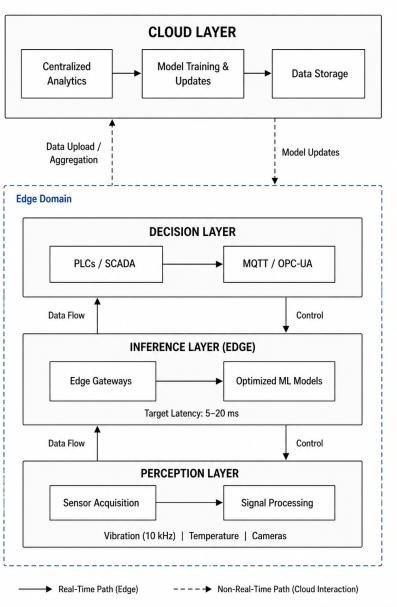
Figure 1 illustrates the perception, inference, and decision modules of our proposed Edge AI-based decision-making framework. In the first step, the perception module acquires the input from sensors and performs pre-processing. After this, the local inference is performed by employing learned machine learning models. Lastly, the control outputs are generated according to the output of inference.
Methodology
Let Total Latency
Ttotal = Tsensing + Tprocessing + Tresponse (1)
Where
Tnetwork = RTT (2)
RTT = Time for data to travel from A to B and back.
For Cloud:
Tcloud ≈ Tsensing + 2Tnetwork + Tcloud−processing (3)
For Edge:
Tedge ≈ Tsensing + Tlocal + Tresponse (4)
This type of computation reduces the delays in network operations due to performing more computations on the local machine, thus transmitting less data through the network [3], [4]. The use of edge computing not only cuts down the response time but also offers stability in the whole process of decision making [3], [4].
Experiment and Expected Results
To understand the distinction between cloud computing and edge computing technology, one can just perform a comparison between them.
This can be done by using an edge computing machine such as Raspberry Pi or Jetson Nano, along with a lightweight CNN model for image classification tasks.
Latency in edge computing technology is in the range of 5-20ms, whereas processing an image through cloud computing takes up to 80-120 ms. So, based on the above example, one can say that edge ai technology drastically cut down the time.
Conclusion
Edge AI removes the bottleneck created by the cloud while providing low-latency response time. Together with real- time decisions made locally, edge AI can open up a lot of opportunities. Through layered architectures, you have more room for tuning. In some cases, hybrid systems can provide you with an option to tune your way between purely edge- based solutions and those based on the cloud. There is more that can be done in terms of compression here.
References
- W. Shi et al., ”Edge computing: Vision and challenges,” IEEE Internet of Things Journal.
- M. Satyanarayanan, ”The emergence of edge computing,” Computer.
- Y. Mao et al., ”Mobile edge computing survey,” IEEE Communications Surveys & Tutorials.
- H. Zhou et al., ”Edge Intelligence,” Proceedings of the IEEE.
- S. Kumar et al., ”Edge Computing in Cloud Environment.”
- S. Kumar et al., ”SDN-Aided Edge AI Systems For Improved Accuracy.”
- S. Kumar et al., ”Edge AI Driven Explainable IoT Framework for Intrusion Detection.”
- S. Kumar et al., ”FaultEdge: An Integrated Fault Tolerance Framework for Edge Computing.”
- Banbury et al., ”MLPerf Tiny Benchmark.”
- Ho, G. T. S. Tang, V., (2024). An Intelligent Decision Support Model for Sustainable Automated E-Fulfillment Centers through Fuzzy Association Rules Mining. IEEE International Conference on Industrial Engineering and Engineering Management (IEEM2024), Bangkok, Thailand, pp. 1397-1401.
- Ho, G. T. S., Tsang, Y. P., Wu, Q., & Tang, V. (2023), “ck-FARM: An R package to discover big data associations for business intelligence”, SoftwareX, 22, 101341.
- Zhou, L., Gupta, B. B., Gaurav, A., Attar, R. W., Alhomoud, A., Arya, V., & Hsu, C. H. (2025). AI-optimized GRU-based self-attention model for predictive diabetes staging in IoT healthcare 5.0. Scientific Reports, 16(1), 307.
- Alauthman, M., Al-Qerem, A., Almomani, A., Ishtaiwi, A. M., Aldweesh, A., Arafah, M., … & Gupta, B. B. (2026). Enhancing Web of Things Security Using Harris Hawks Optimization with Reinforcement Learning. International Journal of Cognitive Computing in Engineering.
- Verma N. (2026) Secure Communication and Access Control in IoT-Enabled 6G Smart Systems, Insights2Techinfo, pp.1,
- Karthik V. (2025) The chain of Trust : Securing IoT in Supply Chain, Insights2techinfo pp.1
Cite As
Ali N. (2026) Edge AI Based Decision System for Low Latency Industrial IoT Applications, Insights2Techinfo