


By: Arshjot Singh, Department of Computer Science & Engineering, CCET (Degree wing), Chandigarh, India
Abstract:
Today, the Internet is becoming a 3D one. Where digital transformation was in the past defined by the movement of data into the cloud, the present day transition is the movement of the user to the cloud. As the Metaverse converges with AI, a new ‘Phygital’ reality arises that has no edges and where interacting in this digital universe will be indistinguishable from interacting in reality. This paper seeks to identify the AI roles that create such immersion, creating deeper intervention with superficial ‘clicks’ and deep experiences which become anchor points, breathe life into business in the 21st Century.
Keywords: AI; Metaverse; Spatial Computing; Consumer Experience; Digital Twins;
I. Introduction: Breaking the “Flat Web”
The earlier digital revolution was mainly about having better, faster and glancing at the website or application for a shorter time. But now, the “flat web” is no more satisfying [1]. Watching on a 2D screen the products for the comparison is similar to physically being inside a shop, with a direct contact with the object. But the Metaverse takes this journey from ‘search for information’ to ‘living in a place’ in a truly digital environment [2].
There is more than just wearing a VR helmet; we can have a digital fabric which is omnipresent and unified everywhere. But the digital universe without intelligence is just a hollow shell. Enter AI. AI will be the ‘brain’ of the Metaverse [3]. It will make these digital universe ‘alive’, ‘adaptive’ and capable of ‘self-expanding’ with the least inputs.
II. The Problem: The Engagement Ceiling
Attention Decay is a big problem for modern digital businesses. Most people are sick of the usual e-commerce interfaces [4].
Static Interaction: Regular apps can’t change in real time to fit a user’s mood or specific needs.
The Physical-Digital Gap: A 2D photo often doesn’t show how big or complicated a product is in industries like manufacturing or high-end retail markets.
Isolation: Standard video calls and other remote collaboration tools often don’t have the “presence” needed for deep creative work.
III. The Synergy: AI as the Metaverse’s Engine
These two technologies are so perfectly coexisting that they serve each other. AI. Deep Learning. The metaverse is impossible to be created at all without AI in the first place [5].
Procedural World Building: Like the implementation of the 3d engine, the designers don’t have to go into the world and have to code every single tree, building etc. Instead, they simply create an editor that generates the content all over the world. For example, a company can generate an event space in seconds with several parameter.
Smart Avatars: AIenabled avatars to do a lot more than just talk. They conversate naturally, read body language and deliver the 24×7’humanlike’ concierge at your service.
RealTime Personalisation: The AI learns how an individual moves and interacts in a virtual environment and changes that environment (lighting, product placement or even difficulty levels in a training simulation) accordingly.
IV. A Framework for Immersive Business
Layer | Functional Goal | Technical Driver |
Connectivity | Ensuring zero-lag interaction. | 5G/6G & Edge Computing[14] |
Intelligence | The logic behind the experience. | Computer Vision, NLP, ML[11] |
Interaction | How the user “feels” the world. | Haptics, AR/VR, Spatial Audio |
Authenticity | Protecting identity and assets. | Blockchain & Secure Digital IDs [6] |
V. AI-Metaverse Integration Framework
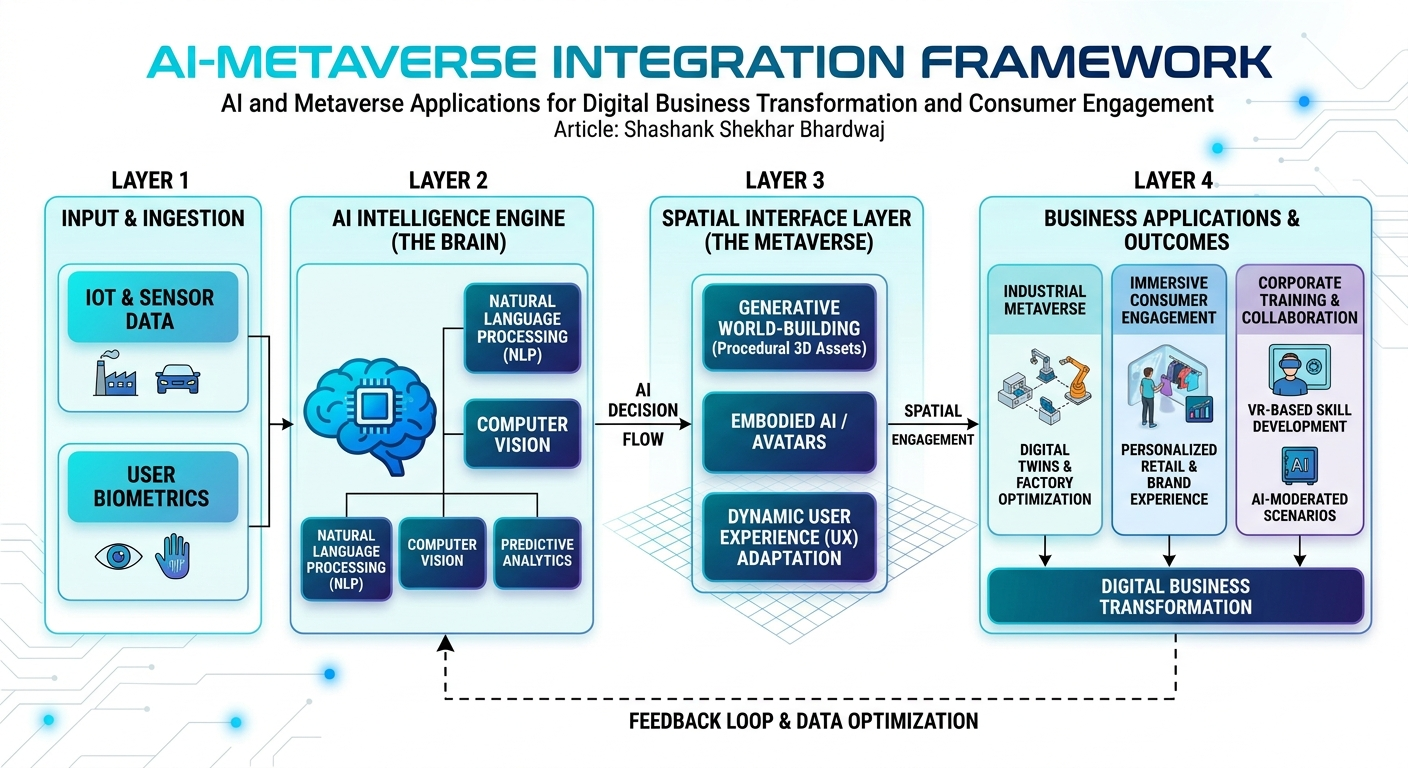
Fig 1: AI-Metaverse Integration Framework
VI. Practical Applications in 2026
There are changes happening in three main areas:
1.Retail: The world’s stores are transforming. Today, people are not only interested in reviewing products. They are used to browse and immerse into them. For example, consumers can get into a car and drive it at the same time while an AI assistant can support them with explanations[4,12].
2. Digital Twins for Industries: Firms are creating factories. They are applying artificial intelligence which will assist them to decide how to optimise a layout[8,13].
3. Learning: People use AI and the Metaverse to learn new things. It’s like you’re practicing somewhere. The tutor containing AI can stop the practice. Give a hand to the person[15].
VII. Conclusion :
Artificial Intelligence and the Metaverse are more than technological enhancements. They indicate a drastic change in the “Human Computer Interaction” (HCI) framework [7-10]. Transitioning from information orientated technologies to experience orientated one will enable the businesses to forge stronger and more meaningful relationships with customers. As time progresses, the distinction between a “place” and a “website” will become irrelevant, leaving behind a virtual world as “user friendly” as this physical one.
References:
- Y. K. Dwivedi, et al., “Metaverse beyond the hype: Multidisciplinary perspectives on emerging challenges, opportunities, and agenda for research, practice and policy,” International Journal of Information Management, 2022.
- H. Hassani, et al., “Artificial Intelligence and the Metaverse: A Review,” Big Data and Cognitive Computing, vol. 7, no. 1, p. 27, 2023.
- Y. Wang, et al., “A Survey on Metaverse: Fundamentals, Security, and Privacy,” IEEE Communications Surveys & Tutorials, 2022.
- R. Cheng, et al., “Will the Metaverse be Next-Generation E-commerce? A Review,” Journal of Theoretical and Applied Electronic Commerce Research, 2023.
- T. R. Gadekallu, et al., “Blockchain for the Metaverse: A Review,” 2022.
- B. Marr, The Future Internet: How the Metaverse, Web 3.0, and Blockchain Will Transform Business and Society. Wiley, 2022.
- M. Ball, The Metaverse: And How It Will Revolutionize Everything. Liveright, 2022.
- NIST, “The Industrial Metaverse: Opportunities and Challenges for Next-Generation Manufacturing,” Special Publication Series, 2023.
- Arthur D. Little, “The Industrial Metaverse: Making the invisible visible to drive sustainable growth,” Prism Executive Series, 2024.
- World Economic Forum, “Navigating the Industrial Metaverse: A blueprint for future innovation,” 2024.
- K. Aggarwal, S. K. Singh, M. Chopra, and S. Kumar, “Deep Learning in Robotics for Strengthening Industry 4.0: Opportunities, Challenges and Future Directions,” 2022.
- A. Sharma, S. K. Singh, S. Kumar, et al., “IoT-enabled smart farming with Industry 5.0,” Journal of High Speed Networks, 2024.
- M. Singh, S. K. Singh, S. Kumar, et al., “Sustainable Framework for Metaverse Security and Privacy: Opportunities and Challenges,” in Proc. International Conference on Cyber Security, Privacy and Networking (ICSPN), 2023.
- R. Singh, S. K. Singh, S. Kumar, and S. S. Gill, “SDN-Aided Edge Computing-Enabled AI for IoT and Smart Cities,” in SDN-Supported Edge-Cloud Interplay for Next Generation Internet of Things, pp. 41-70, 2022.
- T. Vats, S. K. Singh, S. Kumar, et al., “Explainable context-aware IoT framework using human digital twin for healthcare,” Multimedia Tools and Applications, 2023.
- Ho, G. T. S., Tsang, Y. P., Wu, Q., & Tang, V. (2023), “ck-FARM: An R package to discover big data associations for business intelligence”, SoftwareX, 22, 101341.
- Gokasar, I., Pamucar, D., Deveci, M., Gupta, B. B., Martinez, L., & Castillo, O. (2023). Metaverse integration alternatives of connected autonomous vehicles with self-powered sensors using fuzzy decision making model. Information Sciences, 642, 119192.
- Tang, Y. M., Wong, J. K. N., & Ho, G. T. S. (2025), “Exploring Consumer Acceptance of Metaverse Marketing for Branding Activities and the Pre-Purchase Stage”. Journal of Theoretical and Applied Electronic Commerce Research, 20(3), 159.
Cite As
Singh A. (2026) AI and the Metaverse: Redefining Digital Business and Consumer Connection, Insights2Techinfo, pp.1