


By: Gaurav Chahal, Department of Computer Science and Engineering, Chandigarh College of Engineering and Technology, Chandigarh, India, Email: CO24321@ccet.ac.in
Abstract
The rise in the volume of data gathered through multiple sources from IoT devices to multimedia content has made the existing Digital Forensics and Incident Response (DFIR) process obsolete due to the extensive use of manual steps. Investigators are faced with vast amounts of data that cannot be analyzed by any human investigator, leading to the build-up of massive backlogs in the processes of law enforcement agencies and cybersecurity teams. The adoption of artificial intelligence in DFIR has revolutionized the process of evidence gathering, classification, and timelines through the application of Natural Language Processing, Convolutional Neural Networks, and unsupervised anomalies detection [1]. Just like the application of artificial intelligence in the identification of subtle biomarkers not visible to the naked eye in neurodegenerative disorders [6], AI-assisted DFIR allows for the examination of millions of evidence pieces in a matter of minutes.
Keywords: AI Digital Forensics, Incident Response Automation, NLP Evidence Analysis, CNN Forensics, Anomaly Detection, Machine Learning Investigations
1. Introduction
Digital forensics, which deals with acquisition, preservation, and analysis of digital evidence, has witnessed a revolution never seen before in terms of scale and depth. The emergence of the Internet of Things, cloud-based software applications, and encrypted messages has resulted in the creation of huge amounts of evidence that cannot be investigated through conventional means due to the vastness of data [2]. A single cyber attack may result in millions of lines of log files and gigabytes of network traffic that need to be analyzed within the legal timeframe.
The investigation process of DFIR follows a linear approach where the investigator collects evidence, conducts keyword search, and looks for patterns. The methods employed are highly inefficient and error-prone, especially with huge data sets. Artificial intelligence is the answer. As with deep learning algorithms in radiological imaging, which enable the identification of neurodegeneration symptoms overlooked by physicians [6], AI-powered forensic engines[3] can identify patterns in unstructured data that humans cannot find.
2. Core AI Techniques in Digital Forensics
2.1 NLP for Text and Communication Forensics
The NLP technology can process chat messages, e-mails, and logs at an industrial level in an automated manner. Large Language Models perform analysis of email summaries from thousands of emails, identifying semantic patterns of criminals’ intentions, and then grouping those communications according to topics and timelines [1]. There exist software tools such as Belkasoft Evidence Center that employ artificial intelligence assistants which can cluster artifacts and summarize text data automatically, helping the analysts spend their time processing the information in minutes rather than in days. The point is, however, cognitive augmentation because the NLP technology uncovers the codes that keywords will never identify.
2.2 Computer Vision for Multimedia Evidence
These networks can detect and classify suspicious photographs and frames in videos with such accuracy that surpasses human capacity [4]. With respect to child abuse investigations, CNN-assisted classifiers assist in reducing the number of objects that need manual screening by 90% or even more, making sure that investigators avoid any psychological damage. In terms of corporate espionage, object detection and recognition can help in detecting sensitive documents and other confidential labels among a group of unorganized media.
2.3 Anomaly Detection and Behavioural Profiling
Some of the unsupervised machine learning techniques include auto-encoders and cluster analysis, where anomalies are identified by deviation from the current behavioral baseline without using any labeled data [3]. User and Entity Behavioral Analysis (UEBA) technologies create a behavioral profile of the user in time such that any deviations will be detected in real time.
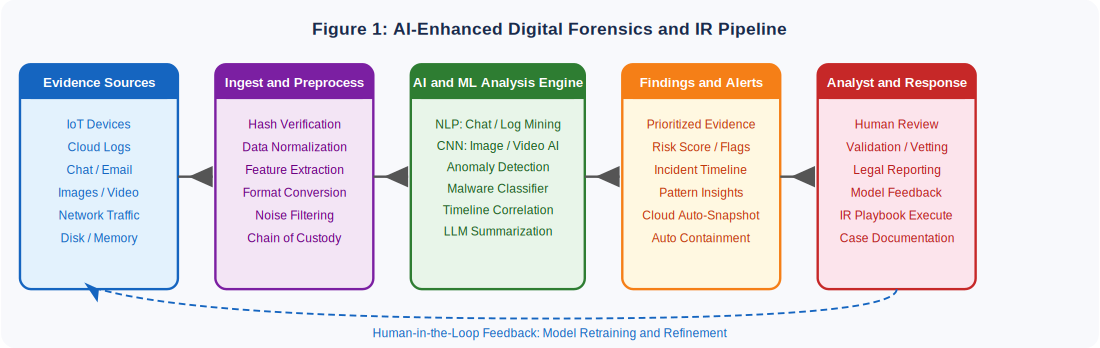
Figure 1: AI-Enhanced DFIR Pipeline — from multi-source evidence ingestion through AI/ML analysis to human-in-the-loop analyst response, with feedback-driven model retraining.
3. Architecture and Workflow
Figure 1 shows how the five stages of AI-DFIR pipeline work. Evidence obtained from diverse sources goes into a pre-processing stage that does cryptographic hash validation (chain of custody), format normalization, and feature vector extraction. The normalized evidence then goes into the AI/ML analysis engine where parallel processing of natural language processing (NLP), Convolutional Neural Network (CNN), and Anomaly Detection happens, delivering prioritized evidence alongside confidence scores and a timeline of the event [5]. Darktrace’s Automated Cloud Forensics 2025 solution provides an example of how the process works. As soon as the event triggers, the software automatically takes a snapshot of the virtual machine before the fleeting data gets lost, which is virtually impossible in manual systems [5].
Table 1: Traditional vs. AI-Enhanced DFIR
Dimension | Traditional DFIR | AI-Enhanced DFIR |
|---|---|---|
Analysis Speed | Days to weeks (manual) | Minutes to hours (automated) |
Data Volume | Limited (human capacity) | Petabyte-scale (ML scalable) |
Evidence Triage | Sequential, error-prone | Parallel, priority-ranked |
Cloud Ephemeral Data | Often missed | Auto-captured on trigger |
Analyst Cost / Hour | Very High | Significantly Reduced |
Table 1 quantifies operational advantages of AI integration across key forensic workflow dimensions.
4. Challenges and Ethical Considerations
The application of AI models in forensic science is undetermined, as it goes against the basic rules of evidence evaluation, which require consistency in the result obtained from the process [1]. The need for explainability cannot be overlooked either. Why should an AI model be able to detect evidence when both the investigator and the court need to understand why neural networks cannot explain themselves? Robustness to adversarial attacks is another problem that arises in relation to AI systems. This refers to the phenomenon whereby the data points used in the process are purposely manipulated by adversarial attackers to fool the system [4].
5. Conclusion and Future Scope
The use of AI in DFIR reflects the required advancement in the digital investigation process. The difference in terms of scale between evidence generation and human abilities to analyze them makes the inclusion of AI inevitable [2]. NLP, computer vision, and anomaly detection technologies cover all major problems faced by forensics – dealing with texts in scale, multimedia in volume, and behavioral analysis patterns. Areas requiring research in the future include Explainable AI technology for court-proven forensic analytics, forensic learning in federated fashion allowing interagency knowledge exchanges, blockchain-enabled audit trail systems for forensic discoveries made by AI, and adversarial modeling of AI systems. With maturation of forensic AI technology, especially through the use of large language models enabling natural language case analytics [6], analysts are going to become interpreters of AI results..
References
- Nayak, M. (2024). AI-enhanced digital forensics: automated techniques for efficient investigation and evidence collection. J. Electrical Systems, 20(1s), 211-229.
- Tageldin, L., & Venter, H. (2023). Machine-learning forensics: state of the art in the use of machine-learning techniques for digital forensic investigations within smart environments. Applied Sciences, 13(18), 10169.
- Zhang, Z., Ning, H., Shi, F., Farha, F., Xu, Y., Xu, J., … & Choo, K. K. R. (2022). Artificial intelligence in cyber security: Research advances, challenges, and opportunities. Artificial Intelligence Review, 55(2).
- Garfinkel, S. L. (2010). Digital forensics research: The next 10 years. digital investigation, 7, S64-S73.
- Manral, B., Somani, G., Choo, K. K. R., Conti, M., & Gaur, M. S. (2019). A systematic survey on cloud forensics challenges, solutions, and future directions. ACM Computing Surveys (CSUR), 52(6), 1-38.
- Rodriguez, R. V., Kannan, H., Shaikh, K., & Bekal, S. (Eds.). (2024). Deep learning approaches for early diagnosis of neurodegenerative diseases. IGI Global.
- Lao, S. I., Choy, K. L., Ho, G. T., Yam, R. C., Tsim, M. Y., & Poon, T. C. (2012). Achieving quality assurance functionality in the food industry using a hybrid case-based reasoning and fuzzy logic approach. Expert Systems with Applications, 39(5), 5251-5261.
- Lau, H.C.W., Ho, G.T.S., Chu, K.F., Ho, W. & Lee, C.K.M. (2009), “Development of an intelligent quality management system using fuzzy association rules”, Expert Systems with Applications, 36(2), 1801-1815.
- Al-Sharif, Z. A., Al-Saleh, M. I., Alawneh, L. M., Jararweh, Y. I., & Gupta, B. (2020). Live forensics of software attacks on cyber–physical systems. Future Generation Computer Systems, 108, 1217-1229.
- Chaudhary, P., Singh, A. K., & Gupta, B. B. (2025). Dynamic multiphase DDoS attack identification and mitigation framework to secure SDN-based fog-empowered consumer IoT networks. Computers and Electrical Engineering, 123, 110226.
- Sahu P. (2024) Chatbots Assistance for Early DiseasChat-Bot Enhanced Digital Forensics: Accelerating Cyber Incident Investigation Processes, Insights2Techinfo, pp.1
- Ivan Cvitić, G. Praneeth, D. Peraković (2021), Digital Forensics Techniques for Social Media Networking, Insights2Techinfo, pp.1
Cite As
Chahal G. (2026) AI-Enhanced Digital Forensics and Incident Response: Automated Evidence Analysis in Modern Investigations, Insights2Techinfo, pp.1