


By: Mehar Juneja, CSE, Chandigarh College of Engineering and Technology, Sector 26, Panjab University, Chandigarh, Email:LCO24380@ccet.ac.in
Abstract
There has been an increase in the creation of digital information in today’s organizations. With the use of Big Data Analytics and Artificial Intelligence, organizations can manage large volumes of information efficiently, both structured and unstructured. An AI-powered Decision Support System (DSS) enhances the performance of organizations through real-time decisions, predictions, and strategic planning. Applications of these systems are seen in several industries like finance, health care, manufacturing, retail, and logistics, among others, in applications such as predictions, customer analysis, fraud detection, and more. It is important to consider other areas which may be difficult in these operations, including information security, bias, and transparency of the system. This paper will include topics such as the utilization of Big Data Analytics and AI-based DSS in organizations, methodology, benefits, and results.
Keywords
Big Data Analytics, Artificial Intelligence, Decision Support System (DSS), Machine Learning, Enterprise Applications, Predictive Analytics
Introduction
Conventional techniques for making decisions cannot work anymore because of the increasing data generation capacity of enterprises. Today’s data comes from everywhere customer purchases, social media activities, sensor readings, website analytics, business data, etc. It is tough to handle and analyze such voluminous amounts of data manually.
Such large data volumes require analysis in order to derive insights, which is made easier by Big Data Analytics.[3] On the other hand, Artificial Intelligence[3] facilitates decision making through the recognition of patterns and predictions of future developments while also providing solutions. Due to their superior abilities to provide timely, intelligent, and accurate decisions, Decision Support Systems that are based on Artificial Intelligence have become an important part of the decision-making process of enterprises[1][2].
Such systems help support a range of enterprise processes like demand forecasting, customer relationship management, fraud detection, supply chain management, and risk management. As the number of rival organizations grows, enterprises are finding it essential to leverage analytics for their operations.
Block Diagram
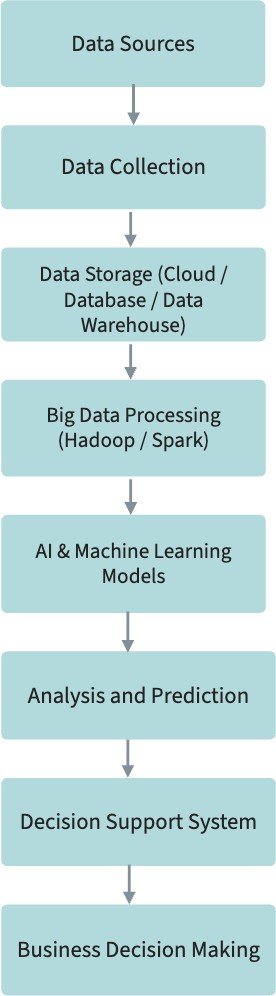
The following figure depicts the collection, processing, and analysis of raw data through the use of various Artificial Intelligence models that will later be fed into the Decision Support System for business decisions.
Methodology
The working of AI-based DSSs begins by collecting information/data from different sources such as the database of customers, IoTs, social networking sites, and enterprise applications. The collected data can either be structured or unstructured in nature.
The process begins with the collection of data followed by its storage on cloud-based platforms or data warehouses. These platforms implement technologies such as Hadoop and Spark for effective management of Big Data [1].
The information obtained through Machine Learning [3][5] analysis includes trends, behavior of customers, risks, and other opportunities that may arise in the future. Predictive models are used by businesses to determine demands, frauds, and operational planning.
The end product of the process is obtained using the Decision Support System. The system uses information provided to managers through reporting systems, dashboards, and artificial intelligence [2] to take decisions for businesses.
Experiment and Expected Result
An enterprise system like retail gathers information about consumer purchasing behavior, browsing history, and consumer responses for analysis. An artificial intelligence algorithm is applied to understand consumer preferences and even predict their future purchases [2][5].
This means that if a consumer regularly purchases electronic items, the program would recommend related goods or personalized deals to them. Likewise, forecasting can be done to manage stock shortages and overstock [8].
Expected benefits include satisfied consumers, efficient stock management, reduced expenses, and effective decision-making. Accurate predictions and relevant business insights help enterprises earn more profit and become competitive in the market.
Conclusion
Big Data analytics and Artificial Intelligence (AI)-based decision-support systems play an important role in modern companies. These tools enable organizations to extract actionable intelligence from massive volumes of data [4]. Although there exist various issues regarding data privacy, data quality, and biased algorithms, all these challenges can be mitigated through proper governance. Appropriate implementation of these tools allows firms to operate efficiently, deliver outstanding customer satisfaction, and excel in the competitive environment. In the future, AI-powered decision support systems will continue to play an essential role in enterprise-level applications and corporate success [6][7].
References
- Chen, H., Chiang, R. H., & Storey, V. C. (2012). Business intelligence and analytics: From big data to big impact. MIS quarterly, 36(4), 1165-1188.
- Davenport, T. H., & Ronanki, R. (2018). Artificial intelligence for the real world. Harvard business review, 96(1), 108-116.
- Provost, F., & Fawcett, T. Data Science for Business.
- Kumar, S., Singh, S. K., & Nelson, L. (2025). Computational intelligence in decision support: Scope and techniques. In Uncertainty in Computational Intelligence-Based Decision Making (pp. 219-238). Academic Press.
- Manyika, J., Chui, M., Brown, B., Bughin, J., Dobbs, R., Roxburgh, C., … & McKinsey Global Institute. (2011). Big data: The next frontier for innovation, competition, and productivity.
- Mengi, G., Singh, S. K., Kumar, S., Mahto, D., & Sharma, A. (2021, September). Automated machine learning (AutoML): The future of computational intelligence. In International conference on cyber security, privacy and networking (pp. 309-317). Cham: Springer International Publishing.
- Brynjolfsson, E., & Mcafee, A. N. D. R. E. W. (2017). The business of artificial intelligence. Harvard business review, 7(1), 1-2.
- Tang Y.M., Ho G.T.S., Lau Y.Y. and Tsui S.Y. (2022), “Integrated smart warehouse and manufacturing management with demand forecasting in small-scale cyclical industries”, Machines, DOI: 10.3390/machines10060472.
- Lau, H.C.W., Chan, T.M., Tsui, W.T., Ho, G.T.S. & Choy, K.L. (2009), “An AI approach for optimizing multi-pallet loading operations”, Expert Systems with Applications, 36(3), 4296-4312.Ho G.T.S., Tang. V., Tong P. H. & Tam M. M. F. (2025), “Demand-driven storage allocation for optimizing order picking processes”, Expert Systems with Applications, 126812.
- Ho, G. T. S., Lee, C. K. H., Tang, V., Chow, E.W.H. (2025). Enhancing AGV Picking Efficiency: Fuzzy Association Rules Mining in Automated E-fulfillment Centers. In The International Conference for Production Research Asia Pacific Region (ICPR-APR), Hong Kong.
- Ho, G. T. S., Tam, M. M. F., Tang, V., Chow, E.W.H. (2025). A Demand-Driven Holistic Management Approach for Optimizing Pick Face Replenishment and Routing. In International Conference on Intelligent Media and Sustainable Technology Management (IMSTM), Osaka, Japan.
- Gupta, B. B., Gaurav, A., Arya, V., & Panigrahi, P. K. (2025). Big data innovations in enterprise information systems: strategies formation for new generation entrepreneurs. Enterprise Information Systems, 19(1-2), 2449261.
- Sahoo, S. R., & Gupta, B. B. (2020). Fake profile detection in multimedia big data on online social networks. International Journal of Information and Computer Security, 12(2-3), 303-331.
- Kasa A.S. (2024) Techniques for Efficient Big Data Storage and Management, Insights2Techinfo, pp.1
- Oktriono K (2024) Fathoming Big Data Analytics for Community-Driven Strategies in Rural Tourism Development, Insights2Techinfo, pp.1
Cite As
Juneja M. (2026) Big Data Analytics and AI-Driven Decision Support Systems for Enterprise Applications, Insights2Techinfo, pp.1