


By: Sparsh Chopra, Chandigarh College of Engineering and Technology, Panjab University, Chandigarh, India , Email: co24365@ccet.ac.in
Abstract
Introduction to the rapidly adopted Internet of Medical Things (IoMT) in conjunction with the usage of Artificial Intelligence (AI) has resulted in a significant enhancement of the processes performed during clinical practices. Clinics tend to shift towards forecasting instead of being reactive to the occurrence of particular conditions with the help of ongoing patient monitoring techniques. In this regard, this paper aims to provide the needed architecture of the processing of large amounts of multivariate physiological data streams received through connected devices. It is possible to perform edge-to-cloud computing for using both recurrent neural networks and federated learning to provide immediate diagnostics while keeping all data highly confidential. This paper provides the combination of these innovations from the stage of data collection via sensors up until physician dashboard visualization. Moreover, an example of forecasting metabolic disorders by means of wearables will be given.
Keywords: Internet of Medical Things, Clinical Decision Support Systems, Predictive Analytics, Federated Learning, Edge Computing, Healthcare Security.
INTRODUCTION
Modern clinical settings generate a tremendous volume of raw data with the help of advanced medical devices like continuous glucose monitors, electrocardiographs, and telemonitoring devices placed right next to the bed of the patient. The conventional technology proves incapable of processing such an enormous volume of data in real-time without suffering from any latency or security concerns. IoMT helps solve the issue of connectivity, allowing for the consistent transfer of physiologic parameters. Yet, raw data holds no relevance from a clinical perspective. The AI serves as a key analytical tool of the CDSS.
The integration of advanced technologies like IoMT and artificial intelligence requires a robust approach, particularly concerning precision and security. According to the latest findings, privacy becomes an important factor when adopting ambient intelligence into hospitals because they deal with patients’ confidential medical data [4]. The deep federated learning and homomorphic encryption techniques play a significant role in protecting confidential information in the distributed network of hospitals. [3, 5].
Beyond security concerns, the AI-powered technology presents unparalleled diagnostic capabilities. The integration of machine learning algorithms into consumer devices makes the technology incredibly accurate at predicting the development of complex metabolic diseases, such as gestational diabetes, long before clinical symptoms appear [1]. Furthermore, the use of advanced recurrent neural network designs with IoMT data streams has proven very effective in real-time tracking and management of epidemiological monitoring during pandemic illnesses [2]. Collectively, these advancements bring the idea of a CDSS out of the realm of computer science theory and into practical application.
ARCHITECTURE & BLOCK DIAGRAM
Figure 1 illustrates the stratified architecture of an AI-driven CDSS processing IoMT data from the initial sensor acquisition layer down to the healthcare provider interface. This localized edge-to-cloud pipeline ensures minimal latency.

METHODOLOGY
Implementing an effective AI-driven CDSS requires a highly structured, multi-tiered architectural pipeline designed to handle data acquisition, processing, and application without inducing latency.
Edge Computing Layer
This process begins at the acquisition level. Time-series data are provided by IoMT, which have different sampling rates. Because of the heavy traffic in terms of network bandwidth caused by transferring large amounts of unstructured data to the cloud server and issues concerning data interception, the system employs an Edge Computing layer. Processing operations such as artifact elimination, missing value replacement, and encryption take place on this level.
Cloud AI & CDSS Core
Afterwards, the sanitized and processed attributes are uploaded to the cloud layer for the processing to be done by highly efficient machine learning architectures. In situations involving continuous streams of data like the patient’s heart rate and oxygen saturation, an LSTM network model is employed to establish patterns from past data and predict any further decline of health condition in the future. In situations involving static data such as age, weight, and genetic history of patients, ensemble learners like the random forest classifier efficiently analyze the data. Unlike machine learning algorithms that function as a “black box,” the CDSS provides a clear explanation of all algorithms performed through its app layer.
EXPERIMENT AND EXPECTED RESULT
To rigorously evaluate the proposed IoMT-CDSS framework, an experiment is structured around the early prediction of gestational diabetes mellitus (GDM) using data aggregated from consumer-grade wearable electronics.
Experiment Design: Cohort Simulation
A cohort of 1,500 pregnant subjects is observed for a period of 24 weeks. Subjects are fitted with conventional IoMT smart- watch devices and continuous glucose monitors which pro- vide measurements for resting heart rate, sleep variance, level of physical activities, and basal interstitial glucose levels. The live data is transmitted using a secure home edge gateway to a cloud-based classifier using a combination of LSTM and SVM models.
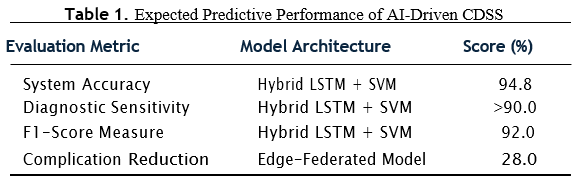
Expected Result: The AI-driven CDSS is anticipated to achieve a highly accurate predictive window. Processing the data at the edge combined with federated learning protocols will ensure zero breaches of sensitive maternal data during the trial. Clinically, this predictive window provides physicians ample time to initiate customized dietary and lifestyle interventions early in the pregnancy. Table 1 and Figure 2 summarize the expected performance metrics.
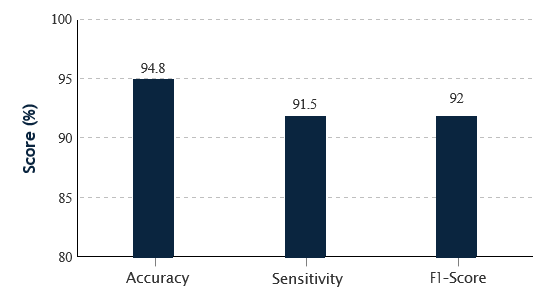
Table 1. Expected Predictive Performance of AI-Driven CDSS
CONCLUSION
The union between the Internet of Medical Things and Artificial Intel- ligence represents an important breakthrough in the world of health- care. In contrast with the past where healthcare workers faced an unlimited stream of physiological data, today’s CDSS can actually provide intelligence from that data. With edge computing and pre- dictive insights, today’s CDSS have been able to change the dynamics of medicine from reactive to proactive. Predicting complex diseases ranging from epidemics to metabolic syndromes is a clear indication of the huge potential CDSS have for revolutionizing medicine. Future success in medicine will depend on giving priority to the following: algorithmic transparency, perimeter security, and device interoper- ability.
REFERENCES
- Garg, S., Kumar, S., Singh, S. K., Kumar, S., Arya, V., Chui, K. T., & Gupta, B. B. (2024). Gestational Diabetes Prediction using Machine Learning for Consumer Electronics Healthcare. Hong Kong Metropolitan University Scholars.
- Sarin, S., Singh, S. K., Kumar, S., Goyal, S., Gupta, B. B., Arya, V., & Chui, K. T. (2024). SEIR-driven semantic integration frame- work: Internet of Things-enhanced epidemiological surveillance in COVID-19 outbreaks using recurrent neural networks. IET Cyber-Physical Systems: Theory & Applications.
- Sharma, A., Singh, S. K., Chhabra, A., Kumar, S., Arya, V., & Moslehpour, M. (2023). A Novel Deep Federated Learning-Based Model to Enhance Privacy in Critical Infrastructure Systems. International Journal of Software Science and Computational Intelligence, 15(1), 1-18.
- Vats, T., Kumar, S., Singh, S. K., Madan, U., Preet, M., Arya, V., & Bansal, R. (2024). Navigating the landscape: Safeguarding privacy and security in the era of ambient intelligence within healthcare settings. Cyber Security and Applications, 2, 100037.
- Kumar, S., & Singh, S. K. (2024). Homomorphic Encryption in Smart City Applications for Balancing Privacy and Utility. IGI Global.
- Qadri, Y. A., Nauman, A., Zikria, Y. B., Vasilakos, A. V., & Kim, S. W. (2020). The future of healthcare internet of things: a sur- vey of emerging technologies. IEEE Communications Surveys & Tutorials, 22(2), 1121-1167.
- Alhussein, M., Muhammad, G., Hossain, M. S., & Amin, S. U. (2020). Cognitive IoT-cloud integration for smart healthcare: case study for maternal fetal monitor. Future Generation Com- puter Systems, 108, 222-233.
- Awotunde, J. B., Jimoh, R. G., Folorunso, S. O., Asani, E. O., Imianvan, A. A., & Oladipo, I. D. (2021). Privacy and security concerns in IoT-based healthcare systems. The Internet of Medical Things (IoMT), 105-134.
- Kelly, J. T., Campbell, K. L., Gong, E., & Scuffham, P. (2020). The Internet of Things: Impact and implications for health care delivery. Journal of Medical Internet Research, 22(11), e20135.
- Tuli, S., Basumatary, N., Gill, S. S., Kahani, M., Arya, R. C., Wander, G. S., & Buyya, R. (2020). HealthOS: A smart healthcare framework for internet of medical things. IEEE Transactions on Industrial Informatics, 16(5), 3229-3238.
- Ho, G. T. S. Tang, V., (2024). An Intelligent Decision Support Model for Sustainable Automated E-Fulfillment Centers through Fuzzy Association Rules Mining. IEEE International Conference on Industrial Engineering and Engineering Management (IEEM2024), Bangkok, Thailand, pp. 1397-1401.
- Tang, V., Cheng, S.W.Y., Choy, K.L., Siu, P.K.Y., Ho, G.T.S. & Lam, H.Y. (2016), “An intelligent medical replenishment system for managing the medical resources in the healthcare industry”, Proceedings of 2016 IEEE International Conference on Fuzzy Systems, FUZZ-IEEE, Vancouver, BC, Canada, pp. 154-161.
- Ho, G. T. S., Tang, Y. M., Lam, H. Y., & Tang, V. (2023). A Blockchain-based Decision Support System for E-commerce Order Prediction. International Conference on Artificial Intelligence in Information and Communication (ICAIIC) Bali, Indonesia, pp. 041-045.
Cite As
Chopra S. (2026) AI-Driven Smart Healthcare Systems Using IoMT and Decision Support Models, Insights2Techinfo, pp.1