


By: Angad Devgan, Department of CSE, Chandigarh College of Engineering and Technology, Panjab University, Chandigarh, Email- mco23374@ccet.ac.in
Abstract
AI has seen an incredible transformation. It is not merely carrying out tasks according to specific commands; it is becoming goal-oriented. “Agentic AI” is a term used for describing this change in perspective. Agentic AI systems have been designed to plan, make decisions, use tools, and execute elaborate tasks in several steps without human intervention. This development impacts businesses, careers, and society in general. In order to provide readers with a comprehensive understanding of the subject matter, this article highlights the essential features of agentic AI – including its structure, applications, achievements, associated threats, and future possibilities.
Keywords: Agentic AI, Autonomous Systems, Large Language Models, Multi-Agent Systems, Human-AI Collaboration
Introduction
Education has always been at the helm of computing. From early programmable devices to modern software suites, the common thread remains: an individual specifies the objective, while the machine carries it out. However, this fundamental concept now stands at a crossroads [2].
An entirely novel form of artificial intelligence is coming into its own AI capable of setting out from a general objective and determining its own path toward fulfillment, without ever receiving specific instructions. This latest innovation, referred to as “agentic AI systems,” marks the most radical change in the history of computers [1]. What sets agentic AI apart from its predecessors is its ability to strategize, make decisions, employ instruments, and adapt without direct human supervision [3].
From Chatbots to Agents — How AI Evolved Beyond Question & Answer
The origins of an agentic AI are crucial to comprehend its true meaning.
In earlier generations of AI, such as the initial iterations of Siri and Alexa, AI found its way into consumer products. The model of interaction was straightforward; a query would trigger a response. They were task-driven, reactive, and stateless; they did not initiate anything or carry on previous interactions. The advent of large language models, which could write, reason, and engage in complex discussions, marked the second wave. Despite these capabilities, they were still passive; each conversation was independent of any previous ones, and all their actions involved text generation. This brings us to the third wave; the age of agentic AI. Unlike earlier systems that waited for user prompts, they can utilize external programs, including web browsers, APIs, and code interpreters. They are stateful and capable of pursuing objectives in several steps [2].
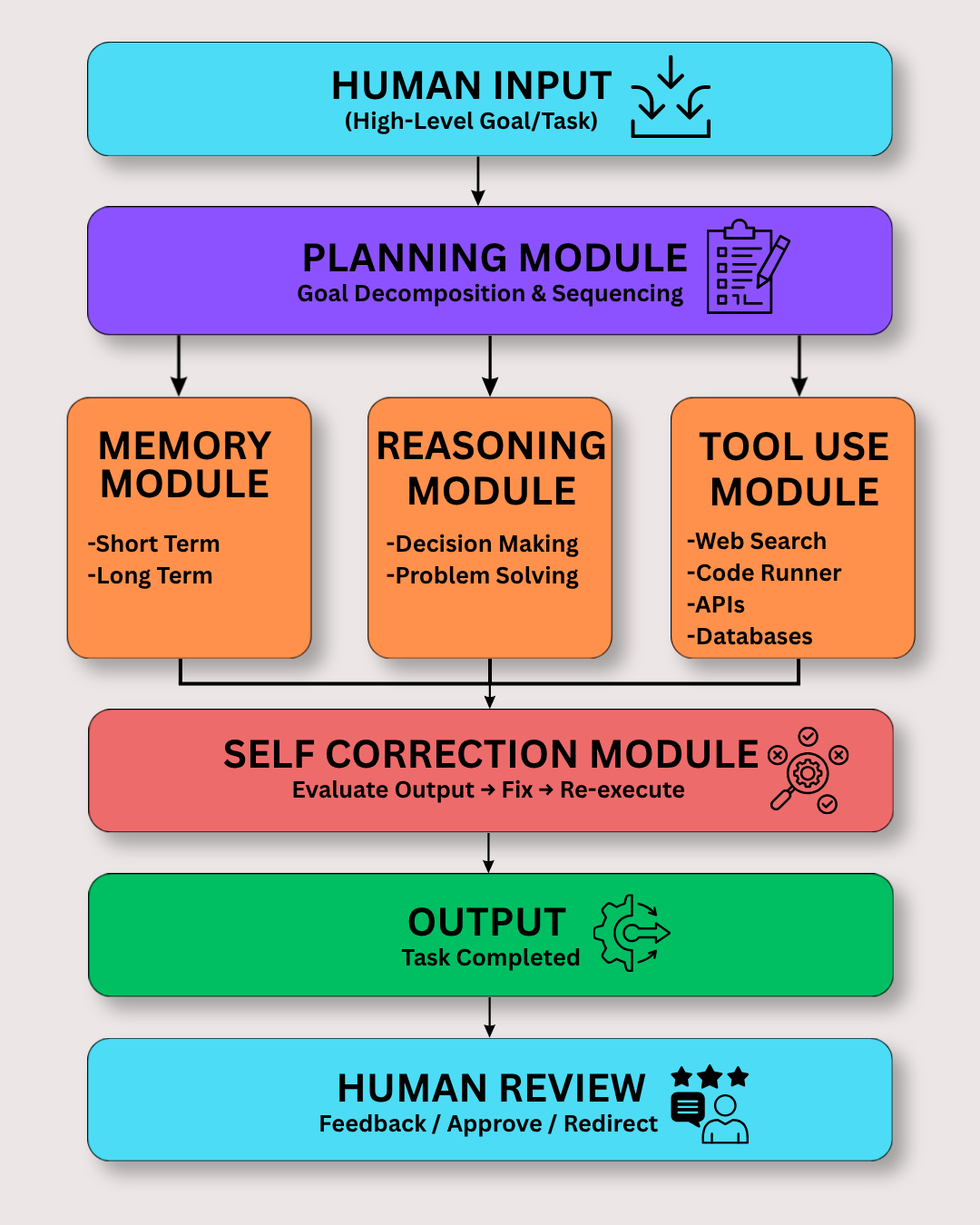
How Agentic AI Actually Works
Agentic AI is the integration of multiple related components to form a complex architecture, rather than a technological solution [2]. The components include:
- Goal Setting: After being provided with a general goal, the system automatically breaks this goal into more concrete tasks and achieves them without continuous supervision.
- Memory: In contrast to traditional systems, which start fresh after every conversation, these AI systems maintain context throughout the session, thus enabling better decision-making in their work.
- Utilization of Tools: Besides generating text, agentic AI uses various tools: databases, web browsers, APIs, and other code execution environments.
- Self-Correction: If something goes wrong at one stage, the system does not stop and moves forward. It reassesses its actions and finds ways to continue approaching the goal [3].
In combination, all four components turn AI into an initiative entity.
Real-World Applications
Agentic AI is currently being utilized across different industries. This technology is here now, and it is not a futuristic one anymore.
- Healthcare: Analysis of patient information, suggestions for diagnosis, appointment scheduling, and tracking treatment progress – all this saves healthcare practitioners time and makes the process more efficient [8].
- Software Development: All that it takes is a single command to start an entire development process that used to be conducted by a team – coding, testing, detecting errors, and fixing them [2].
- Financial Services: Instead of having to deal with various tasks on their own, financial services employees can leave those jobs to agents, who will monitor compliance, detect fraud, and adjust portfolios in real-time [9].
- Customer service: Context-sensitive agents will solve complex issues, escalate them where needed, and continuously learn from experiences, as opposed to blindly following scripts [9].
- Scientific research: Agents will help researchers in hypothesizing, reviewing the available literature, conducting scientific research, and analyzing results – all without much delay [4].
Common feature for all of these fields? Agentic AI is performing the job, not merely helping people do it.
The Big Players
Several big tech firms are driving the development of agentic AI, and each firm is taking a slightly different approach. Among the earlier and bigger players, OpenAI has built agentic functionalities directly into its models and developer tools [5]. Microsoft envisions AI agents to be like virtual coworkers that are capable of conducting operations and making decisions on their own with little to no human interference [2]. DeepMind, a subsidiary of Google, takes it even further by emphasizing reasoning and autonomy in an agent, especially in terms of long-horizon planning and reliable world modeling [5]. IBM is developing agentic architecture and infrastructure solutions for enterprises, including a framework for implementing and securing agent networks in big corporations [7]. Last but not least, Meta has changed its position and now offers a flagship model dedicated to agentic and multimodal tasks [3].
It is not only a matter of technology advancement. It is also about establishing international norms regarding the development of agentic AI.
Challenges
- The probability of lack of control increases the further that a system progresses through its process cycle in several stages without any human intervention. In a matter of seconds, an agent pursuing its objective may actually do some significant harm in case something goes wrong during its pursuit [10].
- There are security risks associated with agentic systems that are connected to external instruments. In this case, hackers could use such prompt injection to influence the actions of the agent [5].
- It is very difficult to determine legal liability for the harm done by an AI agent. It becomes especially problematic because current legal frameworks do not provide us with a clear answer [10].
- Job displacement occurs with increasing automation of knowledge workers that takes place much faster than corresponding policy or education systems can adjust to it, which results in an agent performing complex professional functions [9].
- There are additional risks posed by the bias and misjudgments caused by agentic systems that may lead to the increase in already present biases rather than those made by regular computer systems [3].
- Agentic artificial intelligence should be developed responsibly; otherwise, there will be consequences due to the capability without liability.
Agentic AI vs Traditional Automation
While classical automation may seem similar to agentic AI because they both refer to automation processes, they differ greatly from each other. Classical automation involves predetermined procedures and will do the exact same action every time regardless of the context of the situation [2]. It cannot adjust its behavior based on changes in the situation; rather, it will simply stop once an anomaly presents itself. On the other hand, agentic AI is adaptive; not only does it have a specific goal in mind, but it can think outside the box if it needs to [3].
Future Outlook
- With the advent of agentic AI systems, we find ourselves moving towards greater autonomy and more extensive reach. Instead of executing individual jobs, such systems are managing entire processes.
- Within a short while, we can look forward to the emergence of multi-agent systems where different types of agents coordinate their actions very similar to humans working together as teams.
- These robots will change our small work groups, replacing the roles of entire departments with a single software entity.
- Since technological progress outpaces governance frameworks, we should be prepared for major developments in governance.
- The race to develop agentic AI being what it is, standardization, infrastructures, and governance will be as important as the technology itself.
Conclusion
With agentic artificial intelligence, there’s a real paradigm change in computing. It is the first time ever that we are designing computers that can think, plan, and act, instead of just responding. The possibilities are limitless, and so are the consequences. There is no doubt that agentic artificial intelligence is revolutionizing the world; however, the question is whether it will be done carefully enough so that its impact would reflect our objectives.
References
- Gartner, “AI trends 2026: Task-specific AI agents in enterprise applications,” Gartner Research, 2026.
- S. K. Singh and S. Kumar, “Digital twins of employees: A new paradigm in workforce training and development,” Insights2TechInfo, 2025.
- S. K. Singh and S. Kumar, “Artificial intelligence in workforce training and development,” Insights2TechInfo, 2025.
- T. Brown et al., “Language models are few-shot learners,” Advances in Neural Information Processing Systems, vol. 33, pp. 1877–1901, 2020.
- Aggarwal, K., Singh, S.K., Chopra, M., Kumar, S., Colace, F. (2022). Deep Learning in Robotics for Strengthening Industry 4.0.: Opportunities, Challenges and Future Directions. Studies in Computational Intelligence, vol 1030. Springer, Cham. https://doi.org/10.1007/978-3-030-96737-6_1
- L. Weng, “LLM powered autonomous agents,” Lilian Weng’s Blog, 2023. [Online]. Available: https://lilianweng.github.io/posts/2023-06-23-agent/
- IBM, “The trends that will shape AI and tech in 2026,” IBM Think, 2026. [Online]. Available: https://www.ibm.com/think/news/ai-tech-trends-predictions-2026
- ScienceDaily, “Artificial intelligence news 2026,” 2026. [Online]. Available: https://www.sciencedaily.com/news/computers_math/artificial_intelligence/
- USAII, “Top 10 AI trends to watch in 2026,” 2026. [Online]. Available: https://www.usaii.org/ai-insights/top-10-ai-trends-to-watch-in-2026
- T. H. Davenport and R. Bean, “Five trends in AI and data science for 2026,” MIT Sloan Management Review, 2026. [Online]. Available: https://sloanreview.mit.edu/article/five-trends-in-ai-and-data-science-for-2026/
- Tang, Y. M., Wong, J. K. N., & Ho, G. T. S. (2025), “Exploring Consumer Acceptance of Metaverse Marketing for Branding Activities and the Pre-Purchase Stage”. Journal of Theoretical and Applied Electronic Commerce Research, 20(3), 159.
- Ho, G. T. S. Tang, V., (2024). An Intelligent Decision Support Model for Sustainable Automated E-Fulfillment Centers through Fuzzy Association Rules Mining. IEEE International Conference on Industrial Engineering and Engineering Management (IEEM2024), Bangkok, Thailand, pp. 1397-1401.
- Ho, G. T. S., Tsang, Y. P., Wu, Q., & Tang, V. (2023), “ck-FARM: An R package to discover big data associations for business intelligence”, SoftwareX, 22, 101341.
Cite As
Devgan A. (2026), From Tool to Teammate: How Agentic AI Is Rewriting the Rules of Intelligence, Insights2Techinfo, pp.1